Theology Matters

Faith Virtue Knowledge


Leave a comment

Sounds of Revival: An Unapologetic Apology for Megachurch Worship Practices

During the height of the lockdowns several years ago I participated in an international online conference on megachurch worship practices hosted by the University of Sheffield. It was my privilege to give the keynote address. This address was published in the Journal of Contemporary Ministry under the above title in 2022. Here is the text of the article in full, reproduced with permission from the Journal of Contemporary Ministry. You can find the published article online here. I trust it is helpful. The article generated some discussion and also a published rebuttal. I’ll post that here next week along with my reply.

Introduction

The so-called “worship wars” have long since been fought and won and it seems contemporary worship is here to stay. But this series of papers is not just about the styles and methods of contemporary worship. It is also about megachurches, the vehicles which often define these styles and champion these methods, and develop the pioneer organisations that others follow. For that reason, my purpose in this paper is not merely to describe what does happen in megachurch worship, but to explain why it should and must keep happening. In this respect I differ from a recent and incredibly helpful analysis by Swee Hong Lim and Lester Ruth, Loving on Jesus (Ruth & Lim, 2017), which has helped frame my own thoughts and with which I will dialogue. In what follows, I aim to provide not a history then, but an apology (in the classical sense) for megachurch worship, or, an exegesis of revival. And to be clear, my contention is that that is exactly what is going on. The phenomenon of the megachurch is inextricably linked to its worship practices, and revival is the lens through which both the nature of our Churches and the songs that we sing must be interpreted. Put simply, I contend that revivals, large churches, and new songs go hand in hand. Moreover, I aim to show that they always have done. And for this reason, what is happening in the churches is not something novel, at least in the theological sense. It is deeply rooted in Scripture, it is soundly orthodox theologically, and it is continuous with what has happened in revivals past, dating back to the very birth of the Church. I write as a Pentecostal scholar, and a long-time member of one of Australia’s largest churches, Planetshakers.

In their history of contemporary worship Lim and Ruth (2017), set out nine essential characteristics of what they call “contemporary worship.” While I realise that their study includes churches whose worship may be described as “contemporary” but that are not megachurches, there is sufficient overlap with the context they are examining to use their definition as a basis for discussion of megachurch worship. The nine characteristics are in four general groupings (Lim and Ruth, 2017, p. 2) as listed:

  • Fundamental Presumptions
    • Using Contemporary, nonarchaic English
    • A dedication to relevance regarding contemporary concerns and issues in the lives of worshippers
    • A commitment to adapt worship to match contemporary people, sometimes to the level of strategic targeting
  • Musical
    • Using musical styles from current types of popular music
    • Extended times of uninterrupted congregational singing
    • A centrality of the musicians in the liturgical space and in the leadership of the service
  • Behavioural
    • Greater levels of physical expressiveness
    • A predilection for informality
  • Key Dependency
    • A reliance on electronic technology

My hope is that my thoughts on this will be a resource for those wishing to support and champion the amazing work that megachurches do and their worship practices. But more than that, my hope is that I will be able to provoke or encourage further research in these critical areas. So, with that in mind I present an unapologetic apology for megachurch worship practices.

Before I continue, it is also important to note that hymns have always been important in the life of the church. Most of them — at least the ones that have stood the test of time (here I think of hymns like “How Great Thou Art,” “Be Thou My Vision,” “Holy Holy Holy,” “A Mighty Fortress is our God,” etc.) — have a primarily catechetical function and are thus necessarily laden with important theological terms and concepts. And yet in exhorting the Ephesian believers to “speak to one another in psalms, hymns and spiritual songs” (Eph 5:19), Paul reminds us that this catechetical function is only one among several distinct purposes of church music, which also include, at the very least, the exuberant declaration of God’s mighty acts, the celebration of God’s goodness, and the facilitation of personal encounter with God by the Holy Spirit.1 These additional functions have come to be designated in recent times by the collective term “praise and worship.” Thus, Lim and Ruth demonstrate the evolution of these terms, charting their theology and usage, which according to them has largely been driven by Pentecostal Churches and adopted by others (S. H. Lim & Ruth, 2017, p. 14).

One of the things that I believe Lim and Ruth have gotten profoundly right in their observations about contemporary worship is their discussion of the sacramental quality of worship. Of course, the terminology they use would be entirely foreign to most megachurch attendees, especially to Pentecostals who comprise the vast majority of this group. Their insistence on the terms sacramentalism and liturgy in a work on contemporary worship — apparently an implicit critique of Pentecostalism’s iconoclasm in the first instance and oral culture in the second — is puzzling to say the least. Furthermore, though their appeal to the liturgical terms anamnesis and epiclesismay communicate with precision to scholars in the field, one cannot help but wonder if they would be better served by adopting the more familiar terms associated with the phenomenon they are attempting to analyse, namely praise and worship. But these more traditional classical terms serve to make a very important point, for sacramental theology at its core is the belief that the Church, in its worship, can truly encounter God. That is, that via the sacraments—certain actions or rituals performed that admittedly have certain elements of tradition, but ultimately find their genesis in Scripture—Christians can experience the “real presence” of Christ. In that sense, Pentecostals and Charismatics could certainly be said to have a sacramental understanding of worship (whether or not they use that word), for surely the premise of megachurch worship is to truly encounter God’s presence. But the point is that this expectation of encounter, however it is described and whether (or not) it is actually experienced, is not novel. It is not a recent innovation. It is consistent with the expectation that the Church has always had in its worship, however expressed.

Lim and Ruth’s analysis suggests that Pentecostals have perhaps not gone far enough in developing a theology of God’s presence, and specifically God’s manifest presence, that special moving of the Holy Spirit that most of us know from experience yet struggle to articulate in a way that is defensible outside of our movement. They point to just a handful of texts that are commonly used to establish the expectation of God’s presence in congregational worship. If they are right, and my own experience suggests that they are, then it is incumbent on us, mainly Pentecostal and Charismatic megachurch people, to do the work biblically and theologically to better explain the phenomenology of God’s Presence. And I would commend this as a fruitful direction for further research. But make no mistake, the encounters that are experienced in “contemporary worship” are real. That is not to say that these cannot be simulated or exaggerated or outright faked. Lim and Ruth acknowledge that some churches“…adopted contemporary worship for tactical reasons. Whereas the Pentecostal approach had been to adopt the new music as a way of encountering God, these congregations tended to implement contemporary worship as a strategic way of attracting new people.” (S. H. Lim & Ruth, 2017, p. 131)

And it goes without saying that it is possible at times to misinterpret merely emotional experiences as being “God encounters.” But what seems undeniable, even in the face of the most cynical criticism of megachurch worship, is that people can and do really encounter God in these contexts. Testimonies—anecdotal evidence to be sure, but testimonies too numerous to ignore—describe real encounters with God’s Spirit that have resulted in deep inner healing, instantaneous transformation, miraculous physical healing, refreshing, encouragement, expanded vision, the release of spiritual gifts, and that most important miracle of all, salvation. In short, the encounters that are experienced in the context of megachurch worship are consistent with a context of revival.

It should be obvious by now that, while I am a worship enthusiast, I am not a worship expert. My expertise lies in the area of theology and history. And while the Pentecostal movement of the last hundred or so years is an area of passion area for me because I am part of it, I am far more comfortable in ancient than in recent history. That would certainly be a limiting factor if what we were discussing were indeed a recent phenomenon, but we have already established that the expectation of encounter in worship is not an innovation. What then of the evolution (or perhaps revolution) within the nature of that worship—the songs—that Lim and Ruth document? If their analysis is anything to go by, most seem to have accepted the narrative that this revolution is indeed a recent innovation. But I want to challenge that narrative in two key areas because I believe that the Church is doing now what it has always done, or at least what it has done at its best, that is during previous periods of revival.

The first notion that I want to challenge is that the reason for the undeniable, and at times almost explosive, growth of churches in recent decades is because finally we got our methods right. That is, churches grow big because we make them big. Here, Lim and Ruth tend to support this narrative rather than challenging it. To simplify their argument, Churches until about the 1960s sang hymns with archaic language, and then the Church went through some kind of revolution where language was modernised, and many traditional trappings were shed with relevance becoming paramount. Note here that one of Lim and Ruth’s nine characteristics of contemporary worship is “a commitment to adapt worship to contemporary people, sometimes to the level of strategic targeting” (S. H. Lim & Ruth, 2017, pp. 2, 4). While it is considerably more charitable, I note that this understanding of the recent evolution of “contemporary worship” does share similarities with the typical accusations levelled against megachurches and their leaders by self-appointed church watch dogs and hostile media (for example, see Parsons, 2017).

I first encountered this narrative not long after I had begun attending a Megachurch in Melbourne in the mid-nineties. I was watching Australia’s television program “A Current Affair” over dinner with my parents, who were still disappointed in my ecclesial decision making and felt that they had raised me to be the sort of person that ought to know better. So, you can imagine what an entertaining dinner conversation ensued when a much younger Brian Houston appeared on our screens complete with Hawaiian shirt, trademark winning smile, and larger than life voice. (Hillsong) Pastor Brian became a lot more street wise in his dealings with the media since that time, and at his expense so have the rest of us.

But it is an all-too-familiar script. We have all heard variations of the themes discussed that night. Churches that get big, do so because they compromise the message of the gospel — they don’t preach enough repentance, or they don’t preach about sin etc; they get big because they have a singular charismatic leader; often the founder who holds way too much power and/or has way too much money. Here, the arguments continue as many and various — surely if we throw enough mud, some of it will stick right? Churches get big because they focus not on biblical truth but on entertainment—music, lights, etc. Music entertainment is a clever marketing strategy because after all that is all these big churches are — big businesses. Churches get big because they preach prosperity and faith healing et cetera.

In return, I want to suggest something a little subversive; a little revolutionary. Megachurches are good. They are good for people; they are good for other churches, and they are good for the world. But more than that, people don’t make megachurches, God does. We are not that clever. It is fine to analyse a church from the outside, as indeed Lim and Ruth do with the growth of Willow Creek church and the movement of imitators that it spawned (S. H. Lim & Ruth, 2017, pp. 14, 15). But if you asked my pastor, the pastor of Planetshakers Church, about how the Church started or why it grew as much or as rapidly as it did,2 you would not hear anything about “strategic targeting.” What you would hear about is prayer and the Holy Spirit and being obedient to a word from God. What you would hear is the story of revival. And here is my point. Churches may remain big for a time through methods and systems. But churches do not typically grow big without a genuine move of God.

My main argument is that big churches are evidence of big moves of God; of revival. Big churches make a big impact for God. Big churches are champions of big thinking. They grow big people who do big things. And for sure, they typically have big name leaders with big targets on their backs so when those leaders make even little mistakes those mistakes have big consequences. But both the magnitude and the extent of the disappointment (and even outrage) that is justifiably felt when big leaders fall is testament to the enormous influence that these churches exert within global Christendom, an influence that extends far beyond their official membership. And that should come as no surprise. God has always used larger churches, usually those in significant cities, to influence the direction of the global Church. We think in the early years of the Churches of Jerusalem, Antioch, Alexandria, Caesarea, Rome, and later Constantinople. In the early days of the Protestant Reformation, we might think of the influence of the Church of Geneva or the Church of Oxford. What is significant about these places is that they were all at some time or other, what our megachurches of today are: revival centres.

In earlier times, just as in our own day, big churches were used by God in big ways. They fed the poor, they sent missionaries, they established movements, they often significantly shaped the cities that were in3 and importantly, for our purposes here, they influenced how other churches worship.

And that brings me to the second area I want to challenge in the narrative: the transition away from old songs — the hymns with archaic language — to new songs. I’ll start with this observation. People don’t actually write old songs. We only sing old songs when new ones haven’t been written for a while. In Planetshakers, the Church I am part of, new songs are being written and released on a monthly (and even at times on a weekly) basis. Just this week I was leading our chapel service in Planetshakers College, and I requested a particular song of one of our worship leaders. I didn’t realise, but the song had been written in 2015. Our young worship leader was incredulous. “It’s…five years old! That’s like 20 years in Planetshakers!” The implication was clear. Why sing a song from five years ago when you could sing one from this month??

The truth is that there are so many new songs being sung in churches in this season that we seem to have forgotten it was only a generation ago when we had to sing Amazing Grace every second week because it seemed like the last time a truly great song had been written (Newton, 1779). But that is because what the Church is now experiencing worldwide—and not all parts of the Church, I grant, but make no mistake it IS being experienced in all parts of the world—is revival. This is a revival of the type that we have not seen since that associated with the Methodist movement in the mid to late 1700s. And it is of course no coincidence that “Amazing Grace,” perhaps one of the greatest worship songs of all time and certainly still the most well-known, was written in this period.4

The point is this: songs are always new and fresh; even “contemporary” when they are written and first sung. And this is the case with all the old hymns. The archaic language that they are written in is testament to their enduring quality; many of these older songs are remnants of revivals past. And I mean revivals plural. It is not just the Wesleyan revival that left its mark on the church’s worship. But let’s briefly look at the Wesleyan revival. This example will bear out what I have been suggesting to this point. In addition to large crowds and an experience of the presence of God, many conversions and accounts of supernatural manifestations, also nearly 7000 songs were authored during the period of this revival by Charles Wesley alone, not to mention the other lesser known songwriters of this period. That is a rate of between four and five new songs per week maintained consistently over a thirty-year period! In addition to that, new and innovative methods of church growth were introduced, hence the name of the denomination that grew out of that revival—the Methodists. Methodism represented not a novel theology, but indeed, new methods. In other words, a translation exercise that updated the look and feel of the church for a new era. It sounds a lot like “contemporary worship.”

But what of other revivals? The Protestant Reformation influenced large numbers of people in that many found faith in Christ in and through this movement, particularly in the early stages of it. The word of God was received with joy by large crowds, and new churches were established. What do we also find? This period of revival was one in which many new songs were authored, at least one of which (“A Mighty Fortress is our God”) was sung in the Church I grew up in. Perhaps most significantly was the monumental translation exercise which was commenced, and is still underway, which started with the first vernacular translation of the Bible from the original languages since Jerome’s translation into Latin in the fifth century. Again, new methods, large crowds, mass conversion, new songs, and the updating of language.

Speaking of Jerome’s translation of the Vulgate in the fifth century, it should come as no surprise that its publication similarly coincided with a period of revival among Latin speaking Churches. One of these that we know about occurred through the ministry of Augustine. In the City of God Book 22 chapter 8, Augustine (of Hippo, 2009, pp. 739–749) recounts a series of supernatural miracles of which he himself was personally aware. These miracles he reported (too numerous to recount here) included instantaneous physical healing and the supernatural provision of finance; in fact, the same sorts of miracles that are reported in many megachurches today. The last of these accounts contains the healing of a brother and sister from a disorder that caused persistent uncontrollable shaking. Augustine describes a large crowd and the “sounds of wonder” as a deafening spontaneous praise erupted in response to the miracles (Augustine of Hippo, 2009, p. 749).

Space does not permit further discussion about the many other revivals throughout history, but what I am seeking to establish is that these three things have always gone together: revival, church growth, and new expressions of worship. You cannot separate the three. Revival led to a release of worship. Worship has carried revival. Revival has birthed the megachurch. The megachurch is the vessel for revival.

And so, my conclusion to this point. Neither marketing nor mere sociology is the correct lens through which to view contemporary and megachurch worship. Revival is the correct lens through which to view it. I plead the following: Megachurches and their worship are not a theologically emaciated, hyper-emotional expression presenting a dumbed down version of the gospel. They are not the result of clever marketing strategies (are we really that clever?). These churches are not novel, they are soundly orthodox. Megachurches represent revivals; and their worship invites us to an experience of encounter with God. And while mimicking their methods may produce a measure of ‘success’ for a time, true success is to be found by seeking and obeying God. Lim and Ruth’s work provides a cursory attempt at understanding the biblical theology that undergirds the contemporary Praise and Worship revolution, but without any real insight.

Crucially, these authors have picked up the use of the tabernacle of David typology in Pentecostal literature (though this seems interchangeable for them with the tabernacle of Moses or the Temple of Solomon), but they seem to have largely missed the point of it. They do recognise why it is that of these three, the tabernacle of David is the preferred biblical typology for entering God’s presence. But they seem to think that it is because of “the perceived lack of animal sacrifice in David’s tabernacle” (Lim & Ruth, 2017, p. 127). This is perhaps a helpful insight, but far from the main point. Actually, the tabernacle typology has been used to expound megachurch or revival worship because the Ark in the Old Testament not only represents, but somehow mysteriously carries, God’s Presence. The worship teaching around David’s tabernacle arose for two key reasons. First, unlike the Tabernacle of Moses which preceded it, and the Temple of Solomon that succeeded it, the Tabernacle of David represents a brief prophetic window where there was no veil of separation between the Ark of the Covenant and God’s people when they drew near to worship. Those who developed this typology, and Melbourne megachurch pastor Kevin Conner (1989) is foremost among them (although not the first to introduce the idea), have observed that it was during this period that Israel learned to praise. Similarly, it was during this period that musicians and singers were rostered on literally around the clock to worship God before the Ark, i.e., in God’s presence. During this period many of the Psalms were authored, which is significant.

The second reason why the Tabernacle of David typology is preferred is there is evidence during this time of what we might call ‘revival’. In addition to the large crowds, constant musical worship and new songs being authored, there is also the story of Obed-Edom the Gittite. This man became one of the singers, and this marks the inclusion of a Gentile family into the covenant promises of Israel. In other words, the Tabernacle of David prefigured not merely a worship experience, but the New Covenant itself, where the veil would be torn and the sacrifice would be made once for all. It evoked a time when the Presence of God would become available to all as the Holy Spirit was poured out, and the Good News would be preached. It is this good news that the promises that had once belonged only to Israel were now available to the Gentiles; i.e., to the nations.

And that is why it is the promise about the restoration of David’s tabernacle that the apostle James reads at the council of Jerusalem in Acts 15. This marked a time of revival. This was a time of reinterpretation and the translation of God’s message into the languages of the nations, which occurred first supernaturally on the Day of Pentecost. At the inauguration of the global church, the disciples spoke without having learned the languages of all present, and those who gathered heard them giving glory to God each in their own tongue. This was a time of supernatural manifestation, mass conversions, an experience of the tangible presence of God. Additionally, this was a time when, according to the book of Acts (2:47) the Church was “praising God and enjoying the favour of all the people” and the Lord was adding to their number daily those who were being saved. It was at this time, a time of revival, that James reminded the Church that God would restore in these the last days the Tabernacle of David not merely so that we could have big churches or feel-good songs, but so that all the nations would be able to come into God’s promises and worship him with us.

In conclusion, we cannot and must not cheapen what God is doing through megachurches throughout the world in this generation by merely analysing it. As I have said, megachurch worship invites us: to an encounter to be experienced and shared; it offers us a revival to be embraced and shepherded; and it is rooted in a theology to be received and defended.

Endnotes:

*Please see the published article for the full bibliography.

  1. To be clear, I do not contend that Paul necessarily intends to designate three genres of music in use in the Church, though such a conclusion would not be unwarranted, but rather that his apparent need to use three different words to define the scope of Church music in the first century is parallel to a similarly diverse scope of church music in our own day. New Testament commentators often use the term ‘hymn’ when designating passages such as Philippians 2:6-11; e.g. (Gordley, 2018). If this usage is correct, such ‘hymns’ are certainly theologically rich and catechetical in nature. It should perhaps be noted that theearliest post New Testament hymn, the Phos Hilaron written in the 4th century or perhaps even slightly before, can hardly be said to be ‘theologically rich’ by comparison however. (For some analysis of this see Alexandru, 2020). ↩︎
  2. According to the Brill Encyclopedia of Pentecostal and Charismatic movements, Planetshakers has been the fastest growing Church in Australia’s history (S. Lim & Coombs, 2021). ↩︎
  3. One thinks of the influence that Ambrose exercised over the city of Milan, or John Chrysostom in Constantinople, or indeed Calvin in Geneva. ↩︎
  4. John Newton was not actually a Methodist, though he was certainly a contemporary of John Wesley and no doubt affected by the same revival. The song Amazing Grace was written during a period of prolific hymn writing and growth in his own Church at Olney. For more information see (“Amazing Grace! (How Sweet the Sound),” n.d.) ↩︎


2 Comments

Getting Revelation: Some pointers for reading the Bible’s final book

In periods of great trouble in the world, the Church has instinctively turned to the book of Revelation, and it is doing so again in the troubles of our own day. And though the study of the book of Revelation, along with Daniel in particular, and the other prophetic books, has taken the Church to some strange places, both in the past and in our own day, to turn to it in trouble is the right instinct. For trouble wrests our attention from the temporal, and forces our focus on the eternal. And Revelation speaks loudest to those whose gaze is fixed on Eternity; those whom the troubles of this temporal life have driven to ask eternal questions: Is there a God? If so, what is he doing in the world? Why is there suffering? What is the purpose of life? And…how does it all end? God’s Answer to these eternal questions is Jesus Christ. And that is what (or perhaps Who) Revelation is chiefly about.

Both the name of the book and its fuller title, come from its opening words apokalypsis Iesou Christou… “The Revelation of Jesus Christ…”. The Greek word apokalypsis simply means ‘revelation’ or ‘unveiling’. And it is unfortunate that its English cognate Apocalypse has taken on a whole new (and a wholly different) meaning. And that brings us to the first, and perhaps the biggest problem with the book of Revelation. Why are people confused when they read it? Surely the result of reading a book called “Revelation” should lead to more rather than less clarity! For its title promises a “great unveiling”; the “big reveal.” This is the punchline of History, and it is going to be fully and finally understood. And yet if we are honest, we have to admit that the Church has been all over the place with the interpretation of this book. Many Christians simply gave up reading Revelation, not out of laziness, but out of a feeling that its meaning was hopelessly obscure. I know. I was one of them. And that is a great tragedy! The whole point of the book is that there is something, Someone, that God wants to reveal. This principle will calibrate us in our study of Revelation. If we find ourselves getting confused, or worse, if we find our way to a novel kind of clarity that nobody else shares, then we have missed the point (or perhaps the End or telos, the word that Revelation actually uses). And that is almost certainly because we are just asking the wrong questions.

So, a word about questions. The answers that we get from Scripture depend substantially on the questions that we ask. So it is important to be asking the right questions. This, I believe, is what trips so many of us up when we come to the book of Revelation in particular. For one reason or another, far too many have come to Revelation seeking, in the words of Tony Ling, a “coded message about the end of the world” rather than “the Revelation of Jesus Christ.” To treat Revelation this way is an insidious error for two reasons. The first is that, like the best deceptions, the error carries some truth. Revelation is at the End of the story and thus necessarily concerns the End of our story; indeed of our world as we know it. But the word telos in Greek has a double meaning, just as the word ‘end’ does in English. For the telos is not just the chronological end, but rather the point; the reason for and the meaning of everything. So that when Revelation shines a light on the End, all of a sudden, all of the means to that End can for the first time be understood. But this part of the message is not in code. The good news that God is putting it all back together in Christ, though once a mystery is now revealed. It is not hidden. Revelation spells it out. And this brings us to the second reason. The purpose of all of Scripture is surely to reveal God’s character, nature and purpose through Jesus Christ. In doing so, Scripture at times sheds some light on the Enemy and on what he is up to, but the Enemy is not the main character. We need to approach Revelation asking what it is that God is up to in the world, not what the Enemy is up to. Revelation will not tell us much about the World Bank or the UN (or the US!) or the WHO or Bitcoin or credit cards or the internet. It doesn’t mean to. To ask who the dragon is–John, seemingly anticipates this tendency and tells us almost in exasperation: “that ancient serpent called the devil or satan”–is to miss the Point, the Telos. And when we interrogate Revelation with questions of this nature we not only miss the Point, but we pervert the intent of Scripture as a whole.

I am tempted to say something like the message of Revelation has never been more needed than it is right now. But while that may well be true, its message was sorely needed by the Church at the end of the first century AD, the period when its words were penned. And of course, it has been appropriated in and applied to many other periods of the Church including the Fall of Rome, the Protestant Reformation, the world wars of the 20th century. Is this the hour of the Church’s greatest need? God alone knows, but the Churches of the First century, particularly the Seven Churches of Asia Minor, who were the original recipients of the Revelation undoubtedly thought that their own time was.

And that brings us to the secondary point of Revelation: “…which God gave him to show his servants what must soon take place.” Revelation does not only describe Jesus. There is no question that Revelation also describes events. And much of the argument over the meaning of Revelation concerns the interpretation of these events. Learning to read this genre of Scripture well reminds me of nostalgic memories in my childhood learning to watch cricket well with my Father. I say learning to watch it well, because believe it or not, like Revelation, cricket can be misunderstood if one does not understand the genre of sports broadcasting. Cricket is honestly a slow game. There is plenty of dead space between overs, and even between deliveries. And it has long been the practice of sports broadcasters to fill these gaps with analysis; with comparisons and with replays. When I was very young, this practice “caught me out” many times. I would be watching cricket with my Dad but was tuned out from the commentary. All of a sudden I would see a wicket fall but as I began to celebrate (“Dad! They’ve got another one!!”), my Dad, who was listening to the commentary but not watching the game would calmly say, “No son, that’s only a replay. That’s already happened.” So when I was learning to watch cricket, I got into the habit of asking my Father the following question: “Has this already happened, or is this happening now?” With biblical prophecy, we may do well to add to these two questions a third; “…or is this something that hasn’t happened yet?” Broadly speaking, these three questions correspond to three distinct approaches to Bible prophecy. Simplistically speaking, the belief that the events that Revelation refers to have already occurred is called preterism. The belief that the events describe the history of the world including the history of our own time–i.e. they are presently happening–is called historicism. The belief that Revelation describes future events is called futurism.

These descriptions are of course over-simplified but perhaps sufficient for a starting point. I need to say at the outset that I do not intend to select one of these approaches, or even to describe my reflections in these terms. The reason for this is that I do not believe that they are mutually exclusive. It seems to me self evident–and remember Revelation by definition deals with things that are, or at least are now, obvious–that Revelation describes the reality that the Church in the first century was facing. Even a cursory knowledge of early church history confirms this. But no knowledge outside of the New Testament is necessary. Revelation itself is addressed to actual churches in the First century and deals with, at least in chapters 2 and 3, the circumstances that those churches were facing in that time. So Preterism cannot be ruled out. However, Revelation describes the second coming of Christ and the coming of the New Heaven and the New Earth, which clearly has not happened yet. So Futurism must not be ruled out. And given the premise conceded by the vast majority of interpreters, that at least some of Revelation concerns events which have not yet occurred, historicism likewise cannot be ruled out, since ANY sequence of events detected means that even events future from the perspective if some readers will become present for other readers at some point. And surely it would be ridiculous to suggest that, when stretched taught over now nearly 2000 years, the (ever-problematic) designation “soon”, could not refer to ANY of the intervening events between the first century and our own.
There is one more “school of interpretation that sometimes vies for a place among the other three, and that is ‘idealism.’ The idealist view holds that Revelation describes neither exclusively what will happen, nor what is happening, or even indeed what has happened. Revelation describes in a general sense the sorts of things which tend continually to happen. As with the other views we find this approach to be at times self evident and at other times plain wrong. There are always churches that tend towards loveless legalism, just as there are always churches that are lukewarm that lull themselves into the false belief that they are spiritually alive when they are not. In the same way, what is good and of God is always opposed by what is evil and from the Enemy. But on the other hand, the Second Coming of Christ is not a metaphor, and the end of the world can happen by definition only once. Revelation of course teaches ‘ideally’ as does the rest of Scripture, but this is not the only way that it teaches. Allegories (or parables) are present in Scripture–more so I believe than we often realise–but as the Reformers taught us, we should never stray too far from the literal interpretation of the text. And so here again we find the desire for ‘neatness’ in our approach, which insists that these so-called schools of thought must be mutually exclusive, to be frustrated. They are all useful approaches

So much then to schools of interpretation, and to the division that they bring. Each approach is found to be useful, but only to a point. For when we slavishly adhere to any method, model, or approach to interpretation, we ascribe to method a place that only Scripture should hold and a value that only Scripture possesses. Humility demands that we should at least consider each of the approaches, just as faithfulness to the unique nature and claims of Scripture demands that method submit as servant, not rule as master.

As we approach each part of Revelation in turn then, we should be guided by questions like the following:

What does this passage reveal about the person of Christ? And thus,
What does this passage reveal about the character of God?
What does this passage reveal about the Church’s past? and thus,
What does this passage reveal about the Church’s present?
What might this passage reveal about the Church’s future?
How do the things revealed in this passage bring light to and make sense of other passages of Scripture?
How does this passage contribute to the overall message of the Revelation?


1 Comment

Theology and Experience

Hi all. I have not been blogging for some time now, but revisited one of my first posts this morning in preparation for a Theology lecture at Planetshakers College, and I thought it was worth sharing again. I hope it blesses you.

Clayton Coombs's avatarTheology Matters

My Experience

Several years ago, when I made the decision to leave a job in pastoral ministry to do further training in theology I came up against a common obstacle—particularly common, I might say, in the Pentecostal-Charismatic/non-denom world that I inhabit. Several people questioned (quite sincerely) the wisdom of doing a formal program of study at all. And there was good reason for it. Had we not all witnessed many young people who had once been so zealous for God that they had taken that fateful decision to go to Bible college? And had we not also witnessed these same zealous ones becoming jaded and cynical, losing their ‘edge’, and sometimes losing their faith? Why would anyone want to study theology? The sentiment was most succinctly, and perhaps best put by a good friend who simply said, “The world doesn’t need more theologians, Clayton.” In a sense of course…

View original post 1,163 more words


4 Comments

The Power of the Cross

This morning I’m teaching on the atonement. In preparation I was reflecting on the various ‘theories’ of atonement and was struck by the inadequacy of any single one of them to explain the wonder of what God has accomplished in Christ. I hope you are blessed today by these few lines I wrote in response:

If sin is a disease, the Cross is the cure,

If sin is a poison, the Cross is the antidote,

If sin is a stain, the blood of Christ washes clean,

If sin is a debt, the Cross is full payment,

If sin takes us captive, the Cross is the ransom,

If sin diminishes God’s honour, the Cross restores it.

Where sin leads us far from God, the Cross leads us back

Where sin separates us from God’s love, the Cross restores

Where sin corrupts, the Cross purifies.

Sin has muffled God’s voice, but in the Cross he speaks clearly,

Sin has obscured our vision, but in the Cross all becomes clear.

Sin has marred God’s image, but in Christ it is restored.

The Cross, the sacrifice of Christ, offered once for all.

Its reach is absolute, its mystery is infinite, its invitation universal.

It is complete. It is sufficient. It is final.

IT IS FINISHED.


1 Comment

Audacious Faith for Supernatural Solutions to Enormous Problems

If you are facing a seemingly insurmountable problem, then this is for you. I pray that it blesses and encourages you. 

1 Samuel 14:6

Jonathan said to his young armor-bearer, “Come, let’s go over to the outpost of those uncircumcised fellows. Perhaps the Lord will act in our behalf. Nothing can hinder the Lord from saving, whether by many or by few.”

Nothing can hinder God…

1 Samuel 13 describes in detail the pickle that Israel had gotten themselves into. In the first place, their God-anointed leader, Saul, had disobeyed God’s direct instruction through Samuel bringing judgment both on him and on the nation that he represented before God. In the second, with an army of only three thousand fighting men, Israel had managed to provoke the Philistine army, which was now making preparations to annihilate them. This army, we are told, consisted of six thousand charioteers, two to a chariot, and soldiers on foot ‘as numerous as the sand on the seashore. But the equation only got worse. When Israel saw the position they were in, the army went into hiding in “caves and thickets, among the rocks, and in pits and cisterns.” Most simply ran away in fear. In the end, there were only 600 men left facing a foe of tens of thousands. In the third place, only two men among those 600 carried with them weapons of war. The oppression of the Philistines was such that Israel had been prevented from amassing the necessary arms for the battle. Things could not have gotten much worse. Indeed their situation, had it not been so desperate would have been almost comical. It could only have ended with their doom, were it not for the miraculous power of God. And yet, not even those circumstances could hinder God from what he had chosen to do.

I challenge you today to line up your own circumstances with those Israel was facing. Let faith arise. Let hope arise. Let boldness arise. If God did it then, he can do it now. Nothing can prevent God from saving because saving is essential to his character. Its not about how big your circumstances are. Its not even about how much God loves you (though he loves you more than you can possibly imagine). When it comes to saving, its about God remaining true to his character.

…from saving…
God is into saving because he is a saviour. God is into delivering because he is a deliverer. God is into granting victory over impossible circumstances. Watch how he does it:

1. Audacious faith arises. 

Despite all that had happened to Israel, Jonathan still believed that Yahweh is a God who saves. So do we by the way. The very name of Jesus (Yeshua) upon which we call for our salvation literally means “Yahweh saves.” Indeed this was the purpose of the mission of Jesus to the earth: to reveal God as saviour by effecting our deliverance from the oppressive enemies of sin and death.

But notice that Jonathan’s faith, while audacious, is not presumptious. It does not manifest as a manipulative insistence on a particular outcome. Indeed, it begins only as a flicker of hope—”perhaps the Lord will act in our behalf”. Rather, his faith is manifest in a dogged refusal to allow the present circumstances to compromise the revelation of God as deliverer—”nothing can hinder the Lord from saving…”. This is the same kind of faith that his close friend David will show three chapters later when he confronts the giant Goliath. Like Jonathan, he has no way of knowing whether God would act in a particular way at that particular time. Like Jonathan, David takes what seems to be a reckless punt on God’s unchangeable character. And just as here with Jonathan, God responds, proving true to his character, and delivering not only David, delivering the nation through him.

2. Contagious boldness replaces fear.

Light is stronger than darkness. And in the same way that a little light dispels a lot of darkness, it only takes a little boldness to dispel a lot of fear. The few that were left of the army of Israel, were so afraid that they had taken to hiding in caves and pits and cisterns. And yet as Jonathan decares his faith in God’s character, boldness takes hold. It spreads first to his armour bearer who says in response “Do all that you have in mind…Go ahead. I am with you heart and soul.” It then spreads to the entire army who, emboldened by Jonathan’s success join in the pursuit. 

At any point the Philistines could have woken up to the situation and realised that logically they were the superior army. Their pursuers were far less in number and weaponless. But fear is a funny thing. A little boldness can turn the weapon of fear back on itself. Have you ever thought about that? Fear is one of our enemy’s most effective weapons. Have you ever stopped to consider why? Your enemy fears you. Because he knows that if you will but realise who you are—a son or daughter of the King of kings and thus invested with his full authority and resources; if you will but confess your faith in God’s unchangeable character—an all powerfull God of deliverance who cannot be hindered from delivering from our enemies; if you will but step out in obedient action, your enemy will be utterly defeated. All of the fear and intimidation that keeps you bound and keeps you from pursuing God’s purposes is nothing but a con. Its bluff. Powerful though he may wish you to think him, he knows well what we would do well to remember. He is a defeated foe. Let boldness arise! 

3. A supernatural strategy/solution emerges. 

The idea was so ridiculous that it just might have come from God. But he still wasn’t sure. Jonathan’s plan was to come out of hiding and show himself to an outpost of the Philistines. If the Philistines called out to them to “come up,” that would be the sign that God would give him victory over them. But notice that if they decided to come down to him, that would have meant destruction for him and his armour bearer since they had already given away their hiding place. In other words, once he had committed, there was no safe option. He and his armour bearer would fight for their lives either way.

To follow the traditional route of “inquiring of the Lord” before the battle would have required alerting others to his plan, which would certainly have prevented its execution. Sometimes faith requires us to commit to a course of action and ask God to direct rather than just sitting around and asking God what to do next. And sometimes faith requires us to put ourselves in a position where God has to ‘show up’ or we’re done for.

4. God brings supernatural multiplication.

So Jonathan and his armour bearer did exactly what Jonathan had suggested. They stepped out of their hiding place and challenged the enemy. From this point there was no turning back. And their enemies called out to them to “come up”—the sign. And so, with growing boldness, that’s exactly what they did. They had to climb with hands and feet to reach the Philistine outpost, which in itself would have been exhausting, and as soon as they got to the top, they had to engage in a battle where they were outnumbered at least ten to one. And yet, as they simply spent the energy that they had, God brought a multiplication to their efforts. He supplied what they needed for the climb and for the assault—surely no small miracle in itself—but then God brought a panic on the Philistines. They were in total confusion and began killing each other. Another miracle. And then there was a great multiplication of the resources as the other Israelites came out of hiding and joined in the pursuit.

…by many or by few
And so God brought about a great deliverance for Israel. It was miraculous from start to finish, but in order to accomplish it, he needed somebody to respond to him in faith; to declare the truth of God’s unchanging character, and then to prove that truth by his faith filled action.

Nothing can hinder the Lord from saving, whether by many or by few. In other words, God always acts in a way that is consistent with God’s character. And he is not limited by what we perceive as limitations. If your enemy is debt and you only have a few dollars, if your enemy is stress and you only have a few hours, if your enemy is the godlessness of a city or region and you only have a few people, nothing can hinder God from bringing victory over your enemies. God will deliever by many or by few. The question is, will he do it by you?


4 Comments

Grace #5: Confidence in God’s Grace

The importance of Confidence
Confidence is incredibly important. The world calls it self-belief. And though I often get frustrated when I hear successful athletes and others who seem to have ‘made it’ in the world’s eyes tritely exhorting others to ‘just believe in yourself,’ there is a kernel of truth in what they say. And this is it. Confidence makes things that seemed impossible possible, and gives us the energy and motivation to persevere, even when things look hopeless. Confidence stands up for truth, while others bow down to idolatrous lies. Confidence speaks up for justice while others tolerate the tyranny of the status quo. Confidence steps up for sacrifice, while others hold back in self preservation. Confidence starts up with optimism, while others surrender to the unhappy comfort of procrastination. The one thing confidence does not do is give up, which is why a confident person is so difficult to defeat. And that is where we Christians are at a huge advantage, because we do not have to believe solely in ourselves. We believe in a God who is infinitely greater, but more than that, who loves us, who has gone to extraordinary lengths to have relationship with us, and who empowers us by his Holy Spirit, to do good in the world. So while self-belief might be capable of winning games, God-confidence changes the world for eternal good. It is literally invincible.

Sin and the Grace Plan
Why is it then, that we sometimes lack the confidence to stand up, speak up, step up, start up for God? Why is it that at times we lack the confidence even to come into his presence? The answer: Sin. Or more precisely, the guilt and shame that is caused by sin. And I actually think that was the devil’s motivation for introducing sin into the world. His desire was not the sin itself, but the separation from the heart of God that the resulting guilt and shame would cause. The devil’s plan was to rob us of our sonship (forgive me – I haven’t found a suitable gender neutral term for this, but of course I mean sonship and daughtership – ‘childhood’ just doesn’t have the same ring to it. Suggestions?) and our confidence before God, and thus of our inheritance. He knows how powerful our confidence can be. In 1 John 3:21–22 we are told that

…If our hearts do not condemn us, we have confidence before God and receive from him anything we ask…

His strategy then, is a relatively simple one, and we would do well to be aware of it. All he needs to do is to get us to sin and our own hearts will do the rest through the condemnation of guilt and shame. If our hearts condemn us, we will be separated from God, not because he removes himself from us, but because we ourselves will shrink back from approaching him.
But the devil made one fatal error when he tempted Adam and Eve to sin in the Garden. He activated the Grace Plan. In its simplest form this plan can be found in Romans 5:20

“Where sin increased, grace increased all the more.”

This does not mean that we should “continue sinning so that grace may increase.” Romans 6:2 clearly excludes this—“certainly not!” What it means is that God’s grace is always more powerful than your sin. Sin was never going to win, and it it does not need to win in your life. Jesus has made provision. All we need to do is to turn to God and ask for the forgiveness that his grace has already guaranteed.

The throne of grace
The Grace Plan was not a Plan B. It was plan A. The Incarnate Son of God was already there hidden within the parents of humanity as the “Seed of the Woman.” God was always one step ahead. It was his plan that this Son was to come, not just to give his life as a sacrifice for human sin, but to live his life as an example for human behaviour, and then to ascend back to heaven to take his seat at the Father’s right hand, as the perfect advocate for humanity. So Jesus died in our place to take the punishment that we deserved. That is God’s mercy. And he lived the perfect life also in our place so that we might be accounted righteous before a Holy God. That is God’s grace. That is why the throne that he took at his Father’s right hand is know as the “throne of Grace.” From that throne, he makes intercession for us, representing us to the Father. This is why Hebrews refers to him as our “high priest,” for it was the priest’s role in the Old Testament to stand between God and man offering sacrifices for sins, and interceding for people before God.

Hebrews 4:14–15
Therefore, since we have a great high priest who has ascended into heaven, Jesus the Son of God, let us hold firmly to the faith that we profess. For we do not have a high priest who is unable to empathise with our weaknesses, but we have one who has been tempted in every way, just as we are—yet he did not sin.

Confidence in God’s grace

So what has this got to do with confidence? Everything. It is with sin that the devil causes us the guilt that keeps us from God’s presence. But grace is greater. And so the next verse urges us to approach the throne of grace with confidence:

Hebrews 4:16
Let us then approach God’s throne of grace with confidence, so that we may receive mercy and find grace to help us in our time of need.

When is our time of need? Now! Specifically, any time when our hearts condemn us, when we are feeling guilty or ashamed on account of sin. In other words, the very time that we feel like running and hiding, that is the time to run into his presence, repent and receive forgiveness. The blood of Christ has opened the gates of heaven to us and spoken to the King of kings for us. I’ll finish with the words of an old song by Chris Christensen. Hard to believe its 20 years old this year!

“By your blood I will come boldly,
Run into your presence,
Bow in humble reverence before your throne.
For the blood of Christ has spoken,
The power of sin is broken,
The gates of heaven are open
By your blood.”

Come. Just come. Come now. And come boldly!


2 Comments

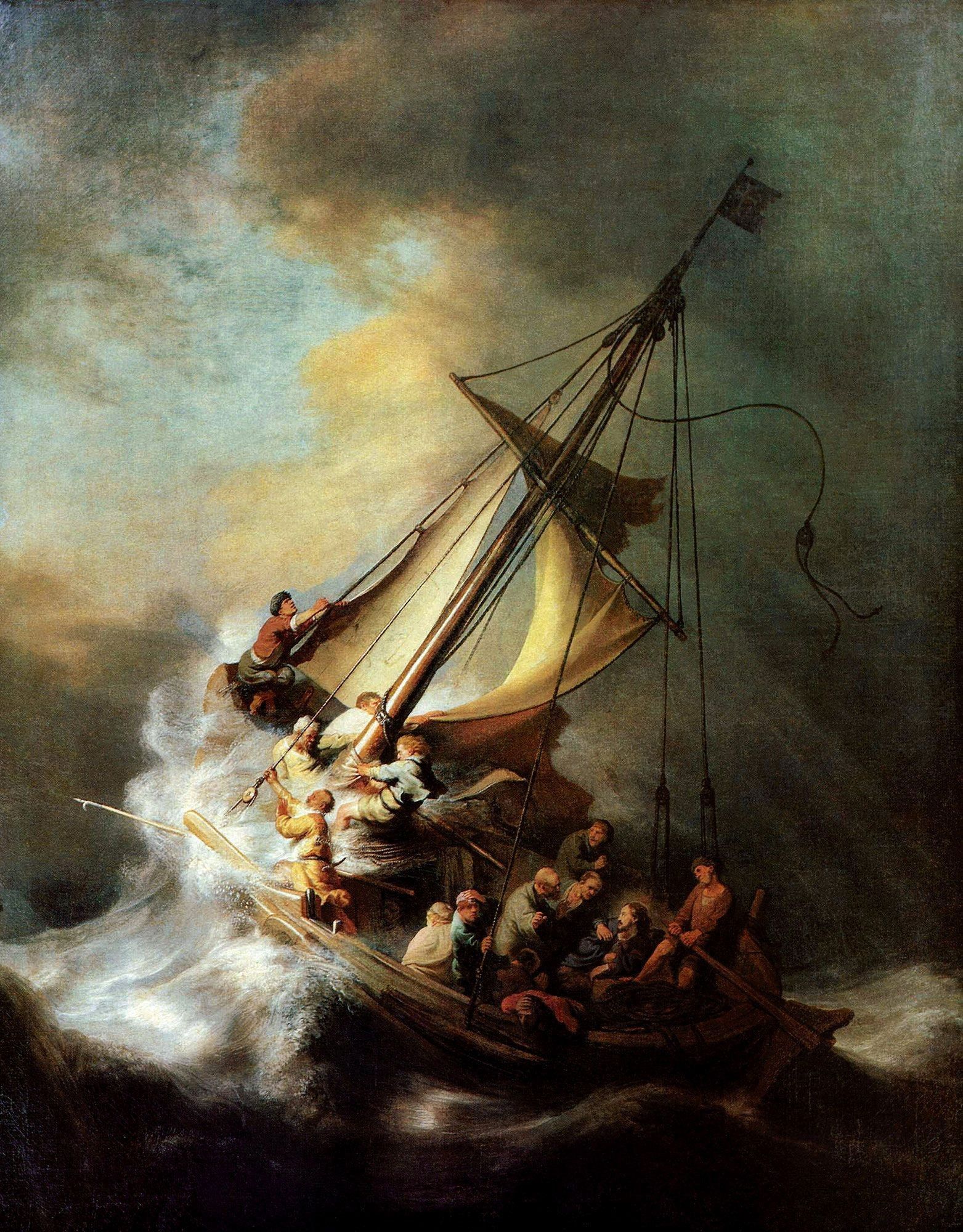
Asleep in the Storm

ImageI thought I might take a break from my grace series. This is a classic painting by Rembrandt of the account in the Matthew 8 (Mark 4) where Jesus calms the storm. As an introduction to my thoughts below, note where Jesus (our example) is in this picture and what he’s doing.

Following is an original poem  (my first!) which I hope will encourage you in any ‘storms’ you may be facing.


Asleep in the Storm

Clayton Coombs (February 26 2014)

“O you of little faith!” the sharp rebuke came.
I am the one who heals the blind and the lame.
Nothing at all is too difficult for me.
So what made you think you would drown in this sea?

“Let’s go to the other side.” Isn’t that what I said?
So what made you think this would end with you dead?
The Father has a plan for what we must do there.
And I want you with me, the experience to share.

My Father has not ordained that today I should die,
Though that day is coming, I feel it inside.
But today is the day for the King to confront legion
For a man to be freed; a seed sown in the region.
That is the reason for which we have come.
And we’re safe in His will ‘til His will has been done.

And so before I deal with the storm and the swell,
The storm within you is the one I must quell.

 Peace! Be still!

Suddenly all was completely becalmed.
How faithless we had been to think we’d be harmed.
For nothing, no nothing can resist God’s intention,
When its declared the circumstances don’t warrant a mention.

May I walk as Your son by faith not by sight,
In God’s spoken word not by power or might.
May my ear be attentive, and true to Christ’s form
May I sleep still and peaceful, whatever the storm.

(Feel free to share if this has encouraged you. For audio of a sermon I preached last year on this passage click here)


5 Comments

Grace #4: The wet man and the umbrella—Truth and Repentance and Faith

ImageI once heard a story about a man who, while walking along the street one day, saw a beggar. That particular morning, there was an ominous storm brewing and the man took pity on the beggar, since it was clear that the latter would not have any shelter. Stopping in a nearby store, he bought an umbrella, which he gave to the beggar with the assurance that it would keep him dry in the coming storm. “Sure it will,” said the latter, with a dubious expression. “Thanks.” But he was not convinced. The other reassured him and hurried on his way. But later in the day, when he returned by the same street after the storm had come and gone, he was dismayed to find the same beggar drenched to the skin, still clutching the gift, in almost the same position as when he had received it. “It doesn’t work,” he maintained stubbornly. He had, of course, failed to open the umbrella. Indeed, he had not even taken it out of its protective sleeve.
This is not a true story, at least as far as I know, but it illustrates well the point that I would like to make in this post. God’s grace is a free gift, but just as the umbrella needed to be unwrapped and put up in order to accomplish the purpose for which it is given, God’s grace must be unwrapped, as it were, and it must be activated.

How to Receive God’s grace
1. Grace and Truth: Unwrapping the umbrella
John 1:17 says:

For the law was given through Moses, but grace and truth came through Jesus Christ.

Grace and truth go together. Or rather, as the verse says, they come together through Jesus Christ. You cannot have grace without truth. And the truth is that since Adam and Eve’s Fall, human beings are born sinful. This means both that we are born under the curse of sin and the sentence of death, and that we are by nature predisposed to sin and thus justly stand condemned not only for Adam’s sin, but also for our own. This truth is known by theologians as “total depravity.” We are born sinners, utterly incapable of saving ourselves by our own effort; incapable even, as Augustine reminds us of willing and choosing to do what is right. That is the condition that God’s grace finds us in. That is the truth. And Jesus didn’t mind telling the truth. I don’t really know why it is that people these days have such trouble with the concept of sin, but I suspect that it has never been a popular message. It just happens to be the truth. When the woman caught in adultery (who I have already introduced in this series) encountered Jesus she encountered both grace “neither do I condemn you” and truth “go and stop sinning.”

2. Faith and Repentance: putting up and holding up the the umbrella
So at the risk of being repetitive, you cannot have grace without truth. Besides, it wouldn’t do you any good. If you don’t actually believe the truth that you are a sinner in need of saving, then God’s grace is really of no use to you. But here’s the deal. You cannot accept God’s truth while still holding onto your own.[1]  To believe God’s truth means to let go of my own, and any behaviour that is based upon it. This is called repentance. In short, repentance is confessing that God is right and I am wrong, and changing my behaviour so that it is consistent with that confession. In the Bible repentance refers to a change of mind resulting in a change of direction. It is in fact, the first word of the gospel “repent and believe.” We usually characterise this as an about-face; a 180 degree turn.[2] But in reality, repentance could also be a 20 degree turn, or a 5 degree turn—a definite, though almost indiscernible change in direction, in response to the Holy Spirit shining his light of truth on a previously dark area. In other words, while our initial appropriation of God’s grace and turning from sin may be dramatic, our subsequent and ongoing repentance will, at least in theory, be less so, though no less important.
If “repent” is the first word of the gospel “faith” (or “believe”) is the second. In order to appropriate God’s grace then, it is necessary that I believe God’s truth about my pre-grace condition. I must let go of whatever else I may have believed about myself and trust entirely in God’s gracious provision in the cross of Christ. When my behaviour matches my belief, I can be said to have repented. However, in order to  remain under God’s grace it is also necessary for me to believe God’s truth about my position in Christ—my under-grace condition, if you will. I am no longer a slave, but a son and an heir. I carry my Father’s royal authority. Actually grasping this truth, allowing it to penetrate our souls, and affect our behaviour, takes practice. And this is why both repentance and faith need to be ongoing. For we will often need to resist and oppose wrong thinking about ourselves, replacing it with God’s truth (we are forgiven, we are new creations in Christ, we are sons not slaves, God’s other children are our brothers and sisters and ought to be treated as such, etc.) in faith. And this will usually necessitate a correction in behaviour, hence ongoing repentance.
In summary, grace without truth is not sincere. Grace without repentance is not effective. Grace without faith is not lasting.

How long will we sit in the rain getting wet, holding the gracious gift that could keep us dry, yet stubbornly insisting that it is legalistic to put it up?

[1] This by the way is why the modern virtue of ‘tolerance’ can only ever be a veneer. It is simply insincere to say “well that’s alright for you” if you do not believe the veracity of the other’s claims. And when we declare that the behaviour, whatever it might be, of another ‘ok,’ we must also implicitly affirm that the truth claim on which that behaviour is based is correct. More on that in another post (maybe).
[2] By the way, from time to time I’ve heard preachers declare, with commendable zeal, that repentance means a “complete 360 degree turn.” It does not. I hate to be pedantic, but that is the only thing that it cannot mean. If you turn 360 degrees, you may be dizzy, but you will still be going the same direction. Trust me. You mean 180.


6 Comments

Grace #3: From slaves to sons and daughters!

For a while now, I have been thinking about the immense subject of God’s grace. My first post in this series outlined the need that I see to ‘beef up’ our teaching of God’s grace. The amazing grace of Jesus does not say to the woman caught in adultery, “neither do I condemn you, I couldn’t possibly,” as the emaciated and far less amazing modern virtue which we call ‘tolerance’ might have done. Neither does it say “go and leave your life of sin so that God can accept you,” as cold pharisaic legalism might wish. God’s amazing grace said then and says now “neither do I condemn you, go and leave your life of sin.” My second post introduced the idea of an obligation that a gift creates, even if freely given. I suggested that while God’s grace saves us freely, we are saved for a purpose, and thus God’s grace invites us rather than obligates us. However, I promised to wrestle further with the notion of obligation in the current post so, here goes. The question of obligation is essentially how ought we to live as a result of God’s grace? The answer to this question will be found in the answer to two more basic questions. What exactly is grace why do we need it?

What is grace?

The Greek word which is translated ‘grace’ in the New Testament is charis[1]. This word refers to favour, or to a favour, and calls to mind the ancient system of reciprocity that operated in the time the New Testament was written. This system is best understood as a never-ending web of mutual obligation, and although some of its unwritten rules survive even to our own day—if you do me a favour, I “owe you one” in return—it was a much more significant part of life in the Roman Empire at the time of Christ. Favours, when exchanged between those of equal standing, equal resources, or equal power, were returned in kind. It was this system that Jesus was referring to when in Luke 14:12–14 he urged his followers not to do favours (such as giving a dinner party) for people who could repay them, but instead for “the poor, the crippled, the lame, the blind…”. Favour could, of course, also be shown by a wealthy or powerful person to somebody of little power. In this case, the favour is returned, though not in kind. A poor or powerless person, if shown such favour, returns the favour by giving honour, loyalty, service and gratitude to the person who showed them favour. This is why charis is also the Greek word for ‘thanks’ as in Romans 7:24, 25 “Wretched man that I am. Who will rescue me from this body of death? Thanks be to God through Jesus Christ our Lord.”[2] God’s grace to us is obviously in this latter category. We bring nothing to the table, but we remain indebted to him for the kindness that he has shown us.

Why do we need it?

Romans 6:15–23 characterises sin not just as acts that lead to death (cf. Heb 6:1), but as a master that we are obligated to obey. Here it is in full with the ‘grace’ language in bold:

15 What then? Shall we sin because we are not under the law but under grace [charis]? By no means! 16 Don’t you know that when you offer yourselves to someone as obedient slaves, you are slaves of the one you obey—whether you are slaves to sin, which leads to death, or to obedience, which leads to righteousness? 17 But thanks [charis] be to God that, though you used to be slaves to sin, you have come to obey from your heart the pattern of teaching that has now claimed your allegiance. 18 You have been set free from sin and have become slaves to righteousness. I am using an example from everyday life because of your human limitations. Just as you used to offer yourselves as slaves to impurity and to ever-increasing wickedness, so now offer yourselves as slaves to righteousness leading to holiness. 20 When you were slaves to sin, you were free from the control of righteousness. 21What benefit did you reap at that time from the things you are now ashamed of? Those things result in death! 22 But now that you have been set free from sin and have become slaves of God, the benefit you reap leads to holiness, and the result is eternal life. 23 For the wages of sin is death, but the gift [charisma] of God is eternal life in Christ Jesus our Lord.

In other words, we are born into servitude to a ruthless master called Sin. God sets us free from this slavery, not by merely turning us loose and allowing us to fend for ourselves. Such a heartless act would be unthinkable, for without a master we are without protection. Rather, he sets us free by purchasing us for himself. At great expense mind you—the exchange literally bankrupts heaven! Now that he has purchased us, Sin is no longer our lord and we are no longer its slaves. But Christ is our Lord, and we now belong to Him. We are no longer under (that is in bondage or servitude to) law, but under grace. That means that we are under the covering of God’s favour. It does not mean that we are now our own masters, free to do as we please. Our freedom is the freedom from our old master, but it comes at the expense of allegiance to the new master. But the greater truth is this. This master has not purchased us in order to subjugate us but to bless us. Because his purpose is to adopt us, who were both slaves and orphans, into his own family.

This means that we enjoy the privileges of the household, and the blessings of the Father’s love. But it also means that we ought to act like members of the household. Paul puts it this way in Romans 8:12 “Therefore brothers and sisters [that is, thos who like him have been adopted into the Father’s household] we have an obligation—but it is not to the flesh, to live according to it.” 

Here are some other ‘obligation’ scriptures (note that obligation, owe, ought, debt all come from the same Greek root):

Romans 13:8 “Let no debt remain outstanding, except the continuing debt to love one another”

Romans 15:1 “We who strong ought to bear with the failings of the weak.”

John 13:14 “You also ought to wash one another’s feet.”

1 John 3:16 “…Jesus Christ laid down his life for us. And we ought to lay down our lives for our brothers and sisters.”

1 John 4:11 “Since God so loved us, we ought to also love one another.”

Ephesians 5:28 “Husbands ought to love their wives as their own bodies.”

OK, this list is not exhaustive, but you get the idea. The obligations that we have are family obligations—to love as we have been loved; to forgive as we have been forgiven. For surely that is how a person who has been blessed and graced in this way ought to act. Love one another. Lay down your lives for one another. Love your wives. Wash one another’s feet. Walk as Jesus did—that is, using the blessings and privileges we have as sons and daughters of the Father, to bless and privilege others.

Bottom line. We have been shown incredible favour. We who were orphans and slaves have been invited to be part of a family. I don’t know about you, but I’m in. I’m grabbing this gift with both hands!


[1] Augustine (rightly, I think) understood the hope-filled answer to the apostle’s anguished cry as “The grace of God through Jesus Christ our Lord.”


[2] This is related to the verb charizomai, which means to give or to show grace towards, and hence also to charisma which is the word used of gifts of the Spirit in the New Testament. This is an important connection, though beyond the scope of the present post, because it reminds us that spiritual gifts, like the gift of salvation, are also operations of God’s grace.


9 Comments

Grace #2: An invitation or an obligation?

I have to be honest. I have really wrestled with this post. In my introductory post to this series, I suggested that the revival of interest in the subject of God’s grace which has occurred in the church over the last couple of decades was sorely needed. But I also suggested that we may be missing something. I don’t at all mean that we preach a half-truth when we say that God’s grace invites us to come as we are, and that there is nothing that we can do to earn or deserve it; it comes free of charge.

“So what’s the problem and why the wrestle?” you might ask.

Well, let me ask a question. How do you imagine the parable of the prodigal son ending? I mean, it doesn’t really end, does it? The younger son goes off into the far country and spends his inheritance on wild living—the inheritance that he had the gall to ask for while his father was still living. He recognises his mistake only when he runs out of money and comes back to the father’s house repentant, begging to be taken on as a servant. His father forgives him and reinstates him as a son. And that’s it—o, except that the older brother is annoyed and won’t join the homecoming party, even at his father’s invitation.

But how does it end? I mean the day after the party. Do you imagine the younger son waking up in the morning and asking for more money so that he can leave again? I imagine him waking up in the morning overcome with gratitude that he has been reinstated and, well, acting like a son again. Of course, if he did wake up and ask for more money and take off again, I’m pretty sure that the father’s heart would again be broken and the father’s arms would again be open. But the son would be missing out.

So here’s my problem.

We all know deep down that a gift creates an obligation. “But wait a minute?” I hear you ask. “That’s not always true. What about Christmas? Surely Christmas is a time to give without expecting anything in return?” Sure, but most gifts at Christmas time (I would say all, but I won’t argue with you if you disagree at this point) are given in the context of an expectation for a gift in return. That’s why so much work goes into arranging a ‘Kris Kringle.’ “Ok, I’ll get one for him, and you get one for me and he can get one for her.” And that’s why you are embarrassed when somebody who you had not thought to get a gift, gets you one out of the blue.

Sometimes this obligation works against us, like when marketers offer us something for ‘free’ in the hope of using the hook of reciprocity to persuade us to purchase something of far greater value. But sometimes the obligation itself works in our favour, like when our parents give us music lessons that obligate us to practice. And sure, as many of us have found, we don’t have to do the practice, but if we don’t, we haven’t really properly received the gift that we were given, have we?

Obligation is a dirty word. Maybe people in our generation are not motivated by duty as people used to be. I don’t know. But I do know that I hate being told that I have to do something, or even that I ought to (that I am ‘obliged’ to). I’d far rather want to. But is it the same with God’s grace? Does the free gift of God’s grace obligate us? In my next post, I am going to continue wrestling with this concept by looking at some scriptures that do seem to imply this. Rom 8:12 is a good starting point if you are interested in sharing your own thoughts in the comments. But for now, let it suffice to say that I believe God’s grace saves us freely, and yet saves us for a purpose. Paul says it better in Ephesians 2:8–10:

For it is by grace that you have been saved, through faith—and this not of yourselves, it is the gift of God—not by works, so that no one can boast. For we are God’s workmanship, created in Christ Jesus to do good works, which God prepared in advance for us to do.

Sure there are good works to do, but the gift of God’s grace is best seen as an invitation not an obligation. The Bible refers to this invitation as a ‘call’ or a ‘calling.’ God has chosen you. God has called you. God has a purpose for you. The question is not whether or not we want to do the good things that God has called us for. Philippians 2:13 makes it clear that God works in us to give us the power both to want what he wants for us, and to carry it out. The question is how we will respond to God’s gracious invitation.

I’ll continue this series in the New year (beginning late Jan). Thanks for reading, and for your comments and feedback thus far. God bless you this Christmas.