Theology Matters

Faith Virtue Knowledge


4 Comments

Grace #1: The Kindness and Severity of God’s Amazing Grace

Consider therefore the kindness and sternness of God: sternness to those who fell, but kindness to you, provided that you continue in his kindness. Otherwise, you also will be cut off. Romans 11:22

God’s Grace is Simple

Some people think of God only as wrathful and judgmental; others as infinitely loving and gracious. Indeed, these are the stereotypical extremes between which the pendulum of Church culture and practice swings, as from age to age and culture to culture, the Church does its best to preach and to embody the good news of God’s restorative love. Both extremes, while they have an element of truth, if taken by themselves are of course inadequate views of God—not perhaps heretical untruths, but lamentable and limiting sub-truths nevertheless. The whole truth is that God is Holy and Loving, Just and Forgiving.

Sometimes, because of the limitations of our understanding, we characterise God’s attributes as if they are in tension with each other. We might say for example, God is love, but since he is also a God of justice, he cannot co-exist with sin. And yet, as theologians remind us, God is simple—that is to say he is not composed of parts. What God is, he is entirely. In other words, though we may at times be, God is not confused. The various aspects of his nature are not in tension. That is (at least partly) why, I believe, the verse above invites us to consider both God’s kindness and his severity. We cannot properly understand one without the other. God’s grace then, is not merely an operation of his kindness, but rather it is an operation of God himself. It must flow therefore from his kindness and his severity, from love and from holiness, from compassion and justice.

Sinners in the Hands of an Angry God, or the big Marshmallow in the sky?

Over the last couple of decades there has been a (sorely needed) revival of interest in and emphasis on God’s grace throughout much of the Church. In part, I believe this has resulted from an increasing realization of just how broken the world is, and how the church has all too often prioritized conformity to a norm over genuine empathy and compassion. We badly needed a grace revival. Nevertheless, it is all too easy for a badly needed theological corrective to become and over-correction. To return to the analogy of the pendulum, I wonder if we are not beginning to swing ‘past the middle’ on this issue. If so, it is certainly not in our teaching of the historic truth of sola gratia (grace alone), but rather in our narrow definition of what God’s grace entails.

I can already hear the objection. “Surely its not possible to overemphasise God’s grace.” True enough. And yet the Scripture with which I began this post invites us to consider both the kindness, and the severity of God. If our proclamation of the gospel emphasises one of these elements at the expense of the other, it may well function as a prophetic message in a particular cultural situation where imbalance already exists, even though it is not the ‘whole truth.’ Jonathan Edwards’ now infamous sermon, Sinners in the Hands of an Angry God, is a great example of this. Edwards preached God’s wrath to a church that was complacent, proud, and dangerously apathetic, in order to provoke a response of repentance. We may well judge Edwards’ sermon (or its title—in my experience, most people who criticise it have never read it) from the perspective of a different cultural situation, as being lopsided, mean-spirited and judgmental. Edwards, it seems, considers only the severity of God, rather than also his kindness. His message is incomplete, but, I would argue, necessarily so. If an imbalance is to become balanced, it requires a counter balance.

In just the same way, however, the ‘grace message’ of today is in danger of considering the kindness of God only, at the expense of his severity. And while this message may perhaps function (or rather, may perhaps have functioned) as a necessary counter-balance in churches and cultures that are overly legalistic, it must be said that the contemporary Church, by and large, is currently somewhere near the opposite extreme. Furthermore, our western culture, into which this Church is called to be a prophetic voice; a culture whose central virtue is tolerance; could not be much further from the legalistic extreme that would legitimate a cheap-grace counterbalance. We need to be aware that a counter balance, if incorrectly placed may cause us to overbalance.

Neither do I condemn you, go and sin no more

My point is that if we define God’s grace as equivalent only to his kindness, rather than flowing from his character, then we limit the operation of grace, which, in its fullest manifestation, both forgives and heals the sinner. The two sides of God’s grace are perhaps most clearly and simply seen in the response of Jesus to the woman caught in adultery: “Neither do I condemn you, go and sin no more.” To respond to sinners with the second part of this saying only—go and sin no more—is clearly legalism, but to omit the second part is only license. True Grace responds with both parts.

It is vitally important that we teach the whole truth about God’s character and hence about his grace. This does not require ‘toning down’ the preaching about grace that has become so popular, but rather beefing it up. Surely if the truth sets us free, then the whole truth will set us completely free. For this reason, I have decided to do a ‘mini-series’ of blog posts on grace over the coming weeks. Stay tuned.


8 Comments

Finish this sentence: “A real Christian could never…”

Would you be prepared to die for your faith?

Around the beginning of the 2nd century (112 AD), Pliny (the younger), the Roman governor of Bythinia-Pontus, sent a letter to the emperor Trajan asking him what was to be done about the spread of Christianity. At that time it was already a capital offense to be a Christian, and one of the problems that Pliny was experiencing was that some people would inform on Christians for no other reason than that they bore them a grudge. Pliny had already executed some Christians, thinking perhaps to eradicate the religion. However, it soon became evident to him that great numbers of people of both genders and at every echelon of the empire professed the new faith.

In his letter to the emperor, a translation of which can be found here, Pliny described his practice of interviewing those accused of being Christians. In order to test the veracity of the accusations, Pliny would ask the defendant to make a sacrifice to the emperor, and to curse Christ, because, as far as he had heard, nobody who was genuinely a Christian could be forced to do either of these things. Can you imagine it? At any time, you could be going about your business and and you could be dragged off and brought before a court. The charges? You are a Christian. The trial could be very short—if you capitulated. “Are you a Christian?” If you said “no”, all you had to do to prove it was to make a sacrifice to the emperor and say “Jesus be cursed.” That would be the end of it…

But the trial could also be mercilessly long. If you said “yes”, you would be tortured to see if they could induce you to curse Christ or to sacrifice. If at length they could not. You would be executed.

Tonight in class, I was reminded of this correspondence and it got me thinking. What if the same were true today? What if it were a crime to be a Christian and the authorities needed some way of proving who was and who was not. We don’t have an emperor today, and we are not in the habit of making sacrifices (at least in the culture I am most familiar with) to idols or political leaders. So I wonder what the test would be. Obviously the ‘cursing Christ’ test would stand the test of time. A true Christian could never curse Christ. But what of the other test?

I’d like to conduct a poll of sorts. Please post your feedback as a comment below.

What is one thing that:

a) the culture around us routinely does and,

b) a Christian could never do?

One more consideration before you comment. Sacrificing to the emperor was not a grey area. It was not an issue of contention between fellow Christians. It was very clear cut. A true Christian could never do it, and if one could, that alone was sufficient proof that they were not a real Christian. I’m looking for a universally shared conviction here, not an opportunity to be judgmental of other Christians.

So here goes. Finish this sentence: “A real Christian could never…”


3 Comments

Contentment: Shhhh! Its a secret!

Content or discontent? You choose.

Php 4:11b–13 “I have learned to be content whatever the circumstances. I know what it is to be in need, and I know what it is to have plenty. I have learned the secret of being content in any and every situation, whether well fed or hungry, whether living in plenty or in want. I can do everything through him who gives me strength.

Discontent is a powerful temptation common to us all. A person who succumbs to it is characterized by restlessness (in the true sense of the word). Such a person lives their life in constant anticipation of elusive ‘if onlys’, which, even if they eventuate, never seem to satisfy the relentless longing for ‘just a little bit more.’  This restless discontent is an enemy of the soul. It shackles a person meant for eternity to the temporal, and yet it robs us of the beauty of the now. Here’s the alarming truth.

 So what’s the secret?

Have you ever wondered exactly what ‘the secret’ is that Paul refers to in Php 4:12? Actually the phrase “I have learned the secret” is a single Greek word that has the sense of being initiated into a secret, or into a secret society. You might not think that “the contentment society” is actually very secret. After all, can’t anybody tell who is content and who is not? Well no, actually. That’s just the genius of a secret society. Membership is obvious, but only to the initiated. Most people assume that you are happy because you have more than they do. So here’s the big secret. Contentment is an attitude you choose. Actually, so is discontentment. And both of them operate independently of our circumstances. It does not necessarily follow that a person the world judges to be ‘poor’ will also be discontent, any more than being rich guarantees contentment. That is because true inner prosperity is measured not by the gap between what I have and what others have—by such a measure I will always find a way of judging myself poor—but by the difference between what I actually need and what I have.[1] By this measure we Christians are rich beyond measure, because the one thing that we really need—friendship with God—is the one thing that nobody can take away from us (Rom 8:38–39).

The secret ways of the contentment society

So that’s the big secret. But how do you do it? How is it possible for Paul to claim contentment in any and every situation (well fed or hungry, living in plenty or in lack)? Here are the secret ways of this society:

1. Trust

True contentment begins with unconditional surrender to God and to his purposes in our lives. And this cannot happen without absolute trust in God’s goodness and love. It is that kind of prevailing trust that causes Paul to see past his circumstances, even in prison, and to rejoice (which as I said in my last post, is a key theme in Philippians). God is good. God loves us. God is in control. These are liberating truths.

2. Perspective

A contented person understands that they are on God’s team, not he on theirs. In 1Tim 6:5 Paul talks about a certain type of Christian that imagines that “godliness is a means of gain.” Paul’s answer (1 Tim 6:6): “Godliness with contentment is great gain.” In other words, God is not primarily concerned with you getting ahead, but rather with the advance of his kingdom in the earth. If by surrender (and surrender is the only way) we join him in this endeavor, we can be certain that all that we (actually) need in order to accomplish all he desires will be amply supplied. But we should also beware that God will at times use apparent lack in order to build our trust in Him, because God is more interested in the measure of our faith than he is in the measure of our possessions.

3. Gratitude

A contented person spends more time thanking God for the blessings that they do have, than they do petitioning him for the things that they do not.

4. Prayer

A contented person chooses prayer over anxiety. Php 4: 6–7 tells us that we need not be anxious (restless) about anything, because in every situation we can bring our requests to God in prayer with thankfulness. If we do this we can truly be at rest in the promise of His peace. This is a “peace that passes understanding.” It defies logic. And it is the legal right only of members of the contentment society.

So what is the secret of contentment? It is the deep conviction that God has supplied and will supply all that I need for all that he has called me to be and to do. This is a place of true rest, true peace, and great gain.


[1] For this insight I am indebted to the great 4th century preacher John Chrysostom of Constantinople. It is found in his second sermon in the series on the parable of the Rich man and Lazarus (Luke 16:19–31). I am not sure of the copyright implications of reproducing the entire sermon (which is wonderful), but you can read the main points here. You can read much of it (see pp. 39–55) here.


2 Comments

I can do all things through Christ! Right?

“I have learned the secret of being content in any and every situation. . .I can do all things through Christ who strengthens me.” (Php 4:11–13)

 I can do all things. . .

The latter part of this verse has been used as a motivation for Christians of all stripes in their endeavours to accomplish all sorts of things. I am old enough to remember when  boxer Evander Holyfield had “Php 4:13” printed on his shorts for his bout with Mike Tyson (which Holyfield won). And anyone who follows American football (and possibly many who don’t) will be aware of the name Tim Tebow, a fine young man who lives  his very public witness for Jesus in the NFL arena, in ways including putting Scripture references such as Php 4:13 on his “Eye Black.”[1]

I need to be clear that it is not my intention here to oppose these sorts of applications of this verse. However, I do want to highlight what this saying actually appears to mean in the context of the book of Philippians, a meaning which need not tether the Holy Spirit’s application of the verse to situations beyond its context, but must surely inform it. Paul, the letter’s human author, is in prison—and not for the first time. In ancient times, prison did not merely entail confinement—the curtailment of certain freedoms, but also physical suffering. Since a prison sentence was considered more of an actual punishment, rather than simply a protection for the rest of society, it was important that there be this component of suffering. In more extreme cases, this involved the ongoing use of torture. The place of confinement was typically (though not always) a place without natural light—at times without any light. Sanitation was non-existent, and in many cases the meals and medical needs of the prisoner were not provided for. If they were to eat, or if they needed treatment of some kind, somebody outside the prison needed to provide for them. Prisoners were often chained hand and foot, were at times suspended from the walls, at times placed in stocks (hands feet and head placed through holes in a beam in order to keep the body in an unnatural position). In short, a normal and reasonable degree of comfort was usually impossible to achieve. The situation was calculated to produce a sense of hopelessness; to break the spirit of the prisoner.[2]

When Paul says “I can do all things through Christ who strengthens me” he is declaring in faith that he can endure his present suffering. He has confidence that whatever befalls him, his spirit will not be broken, and that he will continue to rejoice (a key word in Philippians) and speak of God’s goodness and grace to anyone who will listen. Even in the prison. He is declaring that God’s purposes for his life are not limited just because his physical body is confined to a dungeon. He can pray. He can rejoice. He can write. It is important to realise what Paul is applying this principle of “doing all things through Christ” to in order to see more clearly what he is not applying it to. Obviously, the thing that Paul would have wanted most, along with any prisoner would have been to get out of prison. But if he meant by his famous declaration what many today take him to mean, he would not have been in that prison for more than about five minutes. “I can do all things. . .” would surely have extended to finding a way out of the prison, which was Paul’s most pressing human need, and one that he would have been painfully conscious of every minute of every day of his incarceration. But he does not mean that. He appeals for help to Christ’s strength, not to change his present situation as if his own comfort were the most important thing, but to endure it for God’s glory. “I can do all things” says Paul—even this—“through Christ who strengthens me.”

Can I do all things?

So can we do all things through Christ’s strength? Yes. Absolutely. All of the things (and only those things) that Christ intends for us to do. What we cannot do is appropriate Christ’s power over all things in order to do anything that we might want to do. And what we should not do is to use Philippians 4:13 as some kind of magical incantation to be spoken over whatever difficulty we might encounter—as if God is not ok with taking us along a narrow and difficult path—and thus avoid any deeper work God may wish to do in and through us. Are you experiencing financial lack? “I can do all things” may mean simply believing God for more. But it certainly also mean trusting God that he may have a purpose in the lack. Are you experiencing physical suffering? “I can do all things” may mean trusting God to “get up, take up your mat and walk.” But it certainly means trusting his goodness, even though crippled on the mat until he so bids you. Are you experiencing relationship breakdown? “I can do all things” may mean go ahead and ‘fix it’ with the wisdom Christ provides. But it may also mean trusting God if he chooses to take a longer and more tortuous path to restoration than the one you might have preferred.

So I can do all things through Christ’s strength. As long as all the things that I choose to do flow out of my cultivated intimacy with His heart, my total trust in his character and my absolute surrender to his purposes. Anything I do beyond this, I do in my own strength. And that is not a place where I want to be.


[1]Thick black horizontal lines painted under a player’s eyes which are said to literally “draw light away” from the eyes in order to help a player see the ball better.

[2] This was precisely the type of imprisonment that Paul and Silas had experienced when they had first gone to Philippi, the time when, no doubt, the Philippian Church was established. Philippians was probably written during Paul’s Roman captivity, a period during which Paul (at times) enjoyed better treatment. Nevertheless, he refers several times in Chapter 1 to his ‘chains’ and to his ‘suffering,’ so it is safe to assume that the level of discomfort that he was experiencing ensured that his status, treatment, and condition as a prisoner were never far from his mind.


Leave a comment

Fathers Day Blessing: Rare and Beautiful Treasures

This one is for the Dads, and for the Dads in your life.

Proverbs 24:3–4 By wisdom a house is built,
    and through understanding it is established;
through knowledge its rooms are filled
    with rare and beautiful treasures.

Let’s be honest. All of us like a bit of treasure. For some of us that’s a bigger house or nicer car. For others, priceless artworks and rare artifacts. I, like most other men, particularly men my age (just south of forty), have certain ambitions. And I will admit that being in a ‘better financial position’ (whatever that means) is one of them. I think that is natural, and for the most part, God-given. We desire deeply to provide as best as we can for our families. But relentless focus on the destination can rob us of the beauty of the journey. And as my wife recently reminded me, focusing on the things that we do not have robs us of the blessing of the things that we do have.

My house may not be full of the sort of treasure that more money could buy. Maybe one day it will be, and maybe it won’t. But as a husband and father, my house is filled right now with five priceless treasures—my wife and four children! These are rare treasures indeed, because each of them is absolutely unique. One of a kind!

Dads, it doesn’t matter today whether or not you are ‘up to’ where you thought you might be up to at this point in your life. It doesn’t matter what your achievements may or may not be. It doesn’t matter how much you have or how little of what you want you now possess. You are a Father. You have been given by sheer grace, the gifts of your children. And regardless of how difficult they can be at times, they are unique, and incredibly valuable. You live in a treasure chamber!

Happy Fathers Day.


4 Comments

Does any of it really matter?

 This semester I have the unspeakable privilege of teaching through the New Testament book by book. This week’s lesson was on the gospel of John. Of all of the things that could have ‘jumped off the page’ at me as I read the fourth gospel again in preparation for the class, it was the very last verse that struck me.

 John 21:25

And there are also many other things that Jesus did, which if they were written one by one, I suppose that even the world itself could not contain the books that would be written. Amen.

I must have read this verse hundreds of times, but this time, I got ‘stuck’ on it. Obviously the statement is hyperbole right (an intentional exaggeration employed to make a particular point)? I mean, I’ve been in some pretty large and impressive libraries during the course of studies. The biggest (and probably the best) of them was the Regenstein library at the University of Chicago. Indeed this library, is one of the largest libraries in the world. According to its own website, it holds 4.5 million(physical) volumes, which it has collected through a process of constant acquisition over many years. . .and yet, it takes up somewhat less than a single city block. Here’s a picture:

https://i0.wp.com/upload.wikimedia.org/wikipedia/commons/d/d0/Regenstein_Library_entrance2.jpg

But as I thought about it, a well-known quote came to mind: “you are the only gospel that some people will ever read.” And it hit me. The world has indeed been filled with countless volumes that record the wonderful and miraculous works of Jesus. For just as God promised to write the words of the New Covenant on human hearts, so he has also been recording the works of Jesus onto the very lives of his followers ever since the apostle John penned the statement above. We are those books. And I daresay that if all of his followers over the centuries were alive today, the entire world could scarcely contain their number. And yet, God is not done writing. This very day, God continues to write his story onto the pages of your life.

So next time you are tempted to wonder what the point of it all is, consider this: the purpose of a book lies outside of the book itself. The purpose of the story that God is writing in and with your life, is that it would be read by others, and that in reading the story of your life, they themselves might become acquainted with the Author, enfolding their story into his and surrendering the pages of the coming chapters of their own lives to will of the greatest story teller of all time. As the Psalmist says, “my heart is stirred with a noble theme as I recite my verses before the King, my tongue is the pen of a skillful writer” (Ps 45:1).

In short, God has chosen to display his works in us, so that his own character and nature; his own glory and majesty; his inscrutable wisdom and relentless love may be clearly seen; heard; experienced, by others.


May his works be multiplied in your life today, that others may see Jesus in you.


2 Comments

Forgiveness: Strength in weakness

I forgive you, but its not ok

There is a huge difference between saying “I forgive you” and saying “that’s ok” when somebody apologises. With many smaller offenses, the difference may seem inconsequential, but as we ascend the levels of offense (if you will), the difference becomes clearer and more important. For example, if you accidentally step on my toe and say “I’m sorry,” I may well say in return “that’s ok” or “it doesn’t matter.” We’ll call that ‘level 1.’ If you accidentally run me over with your car however, its not ok. That requires forgiveness. We’ll call this ‘level 2.’ If you intentionally run me over with your car, but later regret it and apologise, (‘level 3’) I may wrestle with my decision to forgive you. But if you intentionally run me over with your car, and never regret it, (‘level 4’) I’m probably going to struggle, and for a long time.[i] It is because of these higher levels of offense, that true forgiveness, the Christian way, has been denounced as powerless, permissive, and passive. It isn’t.

The high cost of forgiveness

I still remember the day my Mum read me the story of the crucifixion for the first time. I don’t mean the sanitised ‘kiddie picture bible’ version “…but they didn’t like Jesus. So they put him on a cross. Then God made him come alive again…”—just the real words of Scripture. A lump began to form in my throat and when it got to this part I could take it no more and began to silently sob: “They stripped him and put a scarlet robe on him, and then twisted together a crown of thorns and set it on his head. They put a staff in his right hand and knelt in front of him and mocked him. “Hail, king of the Jews!” they said. They spit on him, and took the staff and struck him on the head again and again.” (Mt 27:28–31)

The detail is horribly graphic; the stripping and mocking intended to cause maximal humiliation. These men (along with the dehumanizing regime that saw them as expendable weapons of war rather than men) were incredibly spiteful, and utterly merciless. Jesus had already endured an unimaginable flogging, which many did not survive. Now they beat him around the head again and again with a rod (think baseball bat) for who knows how long; each blow driving the spikes from the ‘crown’ ever deeper. All this before the actual crucifixion. They were just getting warmed up. But it was not the graphic detail which brought me to tears. It was the sheer injustice of it. Jesus did not deserve this. And yet, he endured it for me.

Is 53:5–7 tells us that “…he was pierced for our transgressions, he was crushed for our iniquities. the punishment that brought us peace was upon him, and by his wounds we are healed.”

He endured it for us, for my healing and for your healing from the contagion of sin. And even in the agony of his final moments, he begged for the forgiveness of the perpetrators of this crime “Father, forgive them, for they do not know what they are doing.” How truly it is said that he is our advocate before the Father, for this prayer was prayed not just for the soldiers who nailed him to the cross, but for you and for me and for every sinner for whom he died.

Jesus endured it willingly

But he did not endure it passively. On the contrary, propelled inexorably by a love that I cannot imagine, he endured it willingly.

Back in the garden, Jesus made this crystal clear. Seeing Jesus arrested was more than Peter could take. In what can only be described as a fit of characteristic rashness, he drew his sword, slashing wildly in panic (that’s the only conclusion I can draw) and ended up cutting off somebody’s ear. For this, he was met with a rebuke. Jesus declared that if he had chosen, the Father would have put at his disposal ‘twelve legions of angels’ to prevent his arrest and execution (Matt 26:51–54). Make no mistake. Jesus endured the cross willingly. This is what sets the suffering of Christ apart from all other human suffering.[ii] He chose it. And he chose it for our sake. His suffering is not passive; his submission not weak.

And that is why repentance must accompany faith. For when God declares our sins forgiven; when we in faith, appropriate his dying prayer for us, we realise the tremendous weight of our own sin—it was our hands that drove the nails in, though it was not the nails, but rather his love for us that actually kept him on the cross. Our sins have been forgiven at a great cost.

Strong faith-filled forgiveness

I say all that to say this. True forgiveness is not weak. Nor is it passive. When we extend God’s forgiveness of us, that Jesus earned on the cross, to others, as indeed we must; when we say “I forgive you,” it is an act of strong faith. Its not just saying “its ok, it doesn’t matter, its not that big a deal.” Nor is it saying “Well my feelings are not important, so its ok that you walk all over me.” Its not ok. Its never ok. No, saying “I forgive you” is far from passive. It is an active declaration of faith. When we say “I forgive you” we simultaneously declare two things. First, we acknowledge the seriousness of the offense—it was serious enough to send Jesus to the cross. Second, we declare in faith that we believe that Jesus paid the penalty for the offense committed against us. And that his payment is enough. We therefore voluntarily relinquish the right for revenge. It isn’t weak. It isn’t passive. It takes guts. It takes faith. And its powerful and liberating. And as Christians, who have freely received God’s grace, we have no choice but to freely give it to others.


[i] Obviously there are higher ‘levels’ and to think that this progression is strictly linear risks over-simplification, but work with me here.

[ii] I might also add that this puts to bed the ridiculous and frankly blasphemous notion of the suffering of Christ as ‘cosmic child abuse’ put about by those who seem to want to undermine the power of the Cross. But more about this, perhaps, in another post.


Leave a comment

The Good News of God’s wrath

A humorous, yet oddly insightful parenting fail: The wrath of a child

I well remember a day a couple of years ago when our family was grocery shopping in the local supermarket. Two of my sons, seeing a novelty trolley—a two seater car in the front with a steering wheel on each side, a shopping trolley in the back—went over and stood by it, begging me to take it. My other son, realising that there was not enough room for three, very graciously allowed the other two to sit in the car, while he himself sat up in the trolley. After a while in the store, the groceries began to crowd him out and I suggested that he could push, and while he was still a little disappointed that he wasn’t actually in the car at the front he agreed that this would be ok. He’s always been the reasonable sort. It turned out that this arrangement was greatly enjoyed by all, much more so than when I’d been pushing. This was because the son who was pushing, never quite in control of the trolley, which was both heavy and awkwardly long, kept on bumping into things. There were giggles all round. I was nervous and stayed close, enjoying their fun, but trying to make sure nothing got damaged. My hovering proved to be warranted. When we got to the checkout line, I had to suddenly intervene because the one who was pushing, misjudging the momentum of the trolley, or else still unaware of how far forward the front of it actually was, was clearly going to bump into the lady in front of us pretty hard. I grabbed the handle and stopped the trolley just in time, but in the process I accidentally pinched his arm, hurting him pretty badly. He was furious with me. The shock of pain was compounded by the injustice that he felt. Not only had I hurt him—he assumed intentionally—but I had intervened without reason, shattering his cherished perception of autonomy. In his mind he had been in perfect control of the situation. Despite my rapid apology, he impulsively did a perfectly natural thing. He lashed out and hit me. “Why did you hurt me?!” he yelled through his tears. And now I was in one of those classic awkward supermarket moments that every parent dreads. On the one hand, a child hitting a parent is just not on. Had we been home that would probably have been worth a smack and a “Don’t you dare young man!” But there were a couple of complicating factors. First, I felt sorry for his pain. Second, a number of people had heard his question, which seemed perfectly reasonable, because not a soul had witnessed the incident itself. Unsure what to do, I turned to him and said “Did that make you feel better?” “Yes!” he said savagely. “Go on then,” I offered, “do it again.” And so he did. Again and again, until his frustration had subsided somewhat.

The Wrath of God

The above incident made me reflect on my parenting of course, but it also made me think about the wrath of God. Let me explain. When we are hurt; when we are sinned against, it is natural that we should feel the desire for justice, even revenge. I didn’t say it was right. But it is natural. It is this instinct which underlies the basic principle ‘an eye for an eye, a tooth for a tooth’ (Ex 21:23, 24). If two fight, and one loses an eye as a result, he has lost something that he can never regain. He has been robbed of sight in one eye and he can never get it back. And really, the only properly ‘just’ way to deal with this is to deprive the other man of an eye also. You don’t have to be a Christian to get this—only human. In the same way, its only human to want war criminals who have caused terrible suffering to others, to be ‘brought to justice’, that is, to be made to suffer themselves. On a human level we get this. But what we less often realise is that every sin against another is also a sin against God. Every act of rebellion, defiance, disobedience; every act of violence, deceit, malice robs God of the perfect world that he created. That is the thought, I believe, that underlies the discussion of the wrath of God in Romans 1. Here we learn that God’s wrath is being revealed against godlessness, wickedness and suppression of the truth (Rom 1:18). God’s purpose was that the majesty of the Creator would be perfectly seen in his creation, and that His own character and image would be perfectly displayed in humanity. That is why idolatry and sexual immorality, the two sins that are foremost in Romans 1 are linked. The first degrades the majesty of the Creator by worshipping instead created things. The second defaces God’s Image, with which he has indelibly stamped mankind, by the misuse of the body in the pursuit of selfish pleasure at the expense of selfless love. All that to say, God is justly, and rightly angry with sin.

The Love of God

And yet, both the supermarket illustration above, and the notion of God’s anger at his perfect world being destroyed run the risk of portraying God as a petulant child, lashing out because his will has been crossed. And that’s because there is a crucial piece of the puzzle still missing. Here it is. God is Love. He is motivated by Love. He yearns for our good. The perfect world that he created, was created that way so that it could be enjoyed to the utmost. By us. And the reason that God made people in his own image and likeness was so that they might love one another and thus be a blessing to each other. So God is angry at sin not just because it destroys His perfect world, but because that inherent in that destruction is always real pain for real people, people whom he loves dearly. And the fact that we can’t always see the direct connection between our sin and others’ pain—“why shouldn’t I? Its not hurting anyone is it?”—doesn’t mean that God is petty at times, counting those seemingly ‘spiritual’ sins like idolatry as equivalent to the ones like murder, where the human victim is more readily identifiable. It just means that God is omniscient and we’re not.

To put it simply, God’s wrath is not in tension with God’s love. God’s wrath is the consequence of God’s love. And unless we can see that, we will never understand that this God, who is necessarily angry at human sin, is actually for us rather than against us.


6 Comments

Colouring in the Lines: Your Father is the Judge

In my last post, I wrote about the terrible coming Day of Judgment and why, terrifying as it will be, the Christian does not need to fear it. Nevertheless, that Judgment will be terrifying for the unbeliever, not just because of the power of the Judge and the finality of the result (not to mention the awful consequences of receiving an adverse judgment), but because in that Day every secret will be laid bare. Everyone who is not clothed with the righteousness of Christ will appear naked, as it were, before Him. No pretense. No hiding. No excuse. A terrifying prospect indeed.

Let me reiterate what I said in the last post: This judgment is not for the Christian. We have nothing to fear. Jesus, our Advocate, appears on our behalf, bringing with him to court the Book of Life, and reminding the Judge that our case has already been heard, and the verdict is “not guilty.”

And yet, Scripture also makes clear that we will be judged on the basis of what we have done in our lives. In Revelation 22:12, Jesus says

 Look, I am coming soon and my reward is with me. I will give to each person according to what they have done.

How then is that different from the “Great White Throne” Judgment where the dead are judged on what they have done?

Let me assure you, it is as different as night is different from day. To the believer, God is not a judge dealing out punishments to criminals. Rather, he is a Father who delights to hand out rewards to his children. In order to better understand the implications of this, I must take what appears to be an indulgent digression and use an illustration from my own (imperfect) experience as a parent.

What do you see?

Image

This is a colouring page that my 2 year old did. When you look at this, all you see is a mess. The colours do not always match what they are applied to, and there is plenty of scribbling outside of the lines. That’s because she’s not your daughter. Here’s what I see. She’s two alright?! I know where she’s up to. I know what she’s capable of. I’ve seen her work grow and develop since she first put crayon to paper. And I love it. I’m impressed by it. I don’t see all of the colouring outside the lines. That is not my focus. I don’t see all that she has gotten wrong; all that she has failed to achieve in this picture, and all that she should have done better. I don’t see what she hasn’t done. I see what she has done. I don’t see the scribble outside the lines. I see all that she has gotten inside the lines. I don’t see the places where she has gotten the colours wrong. I see the places where she has gotten the colours right. And that is what you’d expect. Because I’m her father. And because of that, she does not need to fear my disapproval when she brings me her work. I am delighted by it. She is assured of my approval because she is my daughter.

That is what it will be like at the ‘judgment’ of rewards. But unfortunately, even though most Christians have some idea of the assurance of their salvation—that they will ultimately be found to be not guilty—many still fear the exposure of that final day of reckoning. If we’re honest, we feel like, alright, its going to be ok. Its all going to pan out in the end, but what a terrible moment when the secrets of my heart are laid bare. How ashamed I will feel, even if only for a moment.

And yet, while your secrets will be revealed, it is not the secrets that you dread. No. They have been taken care of by the Cross. All of your darkest secrets, your hidden sins, your worst moments, your evil thoughts; those shameful things that only you on earth know about; all those things are called forgiven sin. God has promised that he will remove our sin from us as far as the East is from the West (Ps 103:12). Furthermore, he has promised to forget (Is 43:25; Jer 31:34; Heb 8:12). That does not mean that God chooses ignorance over knowledge. It means that God chooses never to call the sin to mind again; never again to raise the issue.

Yes, our secrets will be revealed, but not our dark ones. Jesus tells us, in the sermon on the mount what sorts of secrets will be revealed. All of your ‘acts of righteousness’ which only you and God know about.

Nobody sees when you pray in private. Nobody sees when you fast. Nobody knows the sacrifice of your faith-filled generosity towards others. God sees. God knows. And these things, he does not forget. Nobody saw what it cost you to choose to forgive that person. God saw, and Jesus tells us that “your Father in heaven who sees what is done in secret will reward you.” Nobody knows what it cost you to choose to be selfless in that situation. But God was there. He saw and he rewards.

In short, God, as your father, does not judge you for what is outside the lines. In the case of the picture that is our life, that is called forgiven sin and God chooses to forget.

Of course I am not at all saying that we should “continue in sin that grace may abound.” In the words of the apostle Paul, “God forbid!” But to the yielded and repentant heart that desires above all to please God, God’s heart is not to judge you for what you haven’t done right, but for what you have. He seeks not to expose your dark secrets, but to reward your secret righteousness.

Unfortunately, too many of us see even this judgment of rewards as some kind of a balancing of the good deeds that we have done against the bad. I need to be ruthlessly frank here. That idea is not Christian. God has taken care of the bad deeds on the Cross so that when we repent of our sin he forgives immediately, fully, and finally. He is looking to reward you for all of your good deeds. Whatever they weigh, you will be rewarded accordingly.

What a marvelous motivation to do that for which we were created—the “good works which God prepared in advance for us to do” (Eph 2:10). God is watching. But he’s not watching so that he may catch us out when we make a mistake (though be assured, if we are truly his children, he will certainly correct these), but to reward us when we act righteously.


4 Comments

Good News: Judgment Day is coming!

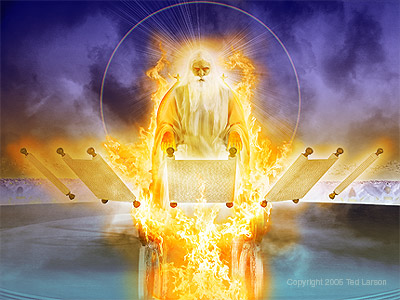
ImageThis picture is an artists representation of Daniel 7:9–10

As I looked, thrones were set in place, and the Ancient of Days took his seat. His clothing was as white as snow; the hair of his head was white like wool. His throne was flaming with fire, and its wheels were all ablaze. A river of fire was flowing, coming out from before him. Thousands upon thousands attended him ten thousand times ten thousand stood before him. The court [or judgment] was seated, and the books were opened.”

It’s a fearsome image. And I’m sure that the picture doesn’t even begin to do the “Ancient of Days” justice. Revelation 20:11 has a parallel description of the judgment, which makes it clear just how fearsome this event will be:

Then I saw a great white throne and him who was seated on it. The earth and the heavens fled from his presence, and there was no place for them.

Why on earth is this good news?!

Before I get to that, I need to make it clear that the coming Judgment is not good news to all. There are good reasons why the notion of a day of reckoning—a day when all accounts are settled—is feared by so many.

The Bad News of the Coming Judgment

First, the God of the Universe, who will preside at this judgment, is a Being of unlimited power. Theologians use the Latin-derived term omnipotence (the omni bit means all and the potence refers to his power) to describe this attribute of God. He has the power over life, death, and eternity, and this is the Day when he will use that power to punish every sin.

Second, unlike human judges, who must always make do with limited and incomplete information, the Divine Judge, has unlimited knowledge. This is referred to as God’s omniscience (from scientia, knowledge—you get the picture). If you actually dwell on this attribute—there is not a single fact, occurrence, thought, deed past present or future that God does not know and see—it is probably the scarier of the two. For many, the fear of exposure is greater than the fear of punishment.  I’m not sure where I got this mental picture from, but I remember hearing somewhere that at the Last Judgment, all of the events of my life would be played on a huge movie screen for all to see. Scripture goes almost as far, for in the ‘books’ that are to be opened is recorded every detail of every life. Make no mistake. This judgment is coming. It will be very public, very scary and very final.

The Good News of the Coming Judgment

But its not all bad news. For this is also a Day when every wrong will be put to rights. Think about it. God’s punishment of sin is a fearful prospect from the point of view of the sinner, but every sin against God also has a human victim and from the perspective of those who have been sinned against, this day will have been long awaited. Finally, justice will be served on the perpetrators of child abuse, war crimes, sex trafficking, genocide, torture, slavery, murder and oppression. Every time a powerless victim cried out to God for justice; every time a dispossessed people raged against their oppressors to no avail; every time a little child’s pleas for mercy fell on deaf ears, God was watching, God was listening and God will make it right. This is the Day about which Romans 12:19 is written:

Do not take revenge, my dear friends, but leave room for God’s wrath, for it is written: “It is mine to avenge; I will repay,” says the Lord.

And to the many who (sometimes quite rightly) think that “life isn’t fair,” this is good news indeed.

The Great News of the Coming Judgment

But the best news is yet to come. You don’t even have to appear at this judgment. Jesus will appear for you—if you let him. You see, when that great and terrible Judgment is seated, as Daniel tells us, the books of record will be opened. But Revelation 20:12 speaks of another book that is opened at this time. This is the Book of Life, and if your name is found in that book, the result of your case is assured. In fact, John 5:24 tells us that your case will not even be heard. In this verse Jesus assures us that

the one who hears my word and believes in the one who sent me has eternal life and does not come into Judgment because that person has already crossed over from death to life.

In other words, for the person who trusts in Christ, the judgment has already taken place. It took place in Christ because he was sentenced in my place on the Cross. In the words of “The Pulpit Commentary”: “The judgment is over, the books are closed, the condemnation is no longer possible.”

Romans 8:1 puts it this way:

There is therefore now no condemnation for those who are in Christ Jesus…

Condemnation is a word associated conceptually (and lexically in the Greek) with Judgment. It refers to an adverse judgment and the sentence of punishment that accompanies it.

Based on these verses, I imagine a scene where God almighty sits on the great white throne (as in Revelation 20; Daniel tells us only that it is on fire) in the final judgment. On the table in front of him are the books of record. But beside this, lies open, the Book of Life. As each name is read out, it is cross-checked against this Book. If a person’s name is found there, the case is dismissed. And guess who is there doing the cross-checking? Jesus himself. After all, Rev 21:27 refers to this as “the Lamb’s Book of Life.” As the “advocate with the Father” (1 John 2:1) Jesus actually attends the court in our place. But he attends this court, not to plead our case, but simply to remind the court that the case has already been heard and decided in our favour. That, after all, is what justification means. We have been found to be “not guilty” because of Christ’s sacrifice for us on the cross.

Let me be clear. If you have placed your trust in Christ, your case has already been heard. Beside your name in the great books of record then, will be written this simple summary of the case: “Not guilty. Covered by Christ’s righteousness.”

That is why believers in Christ should not fear the final judgment. We do not need to appear before the court because the outcome has already been decided.

Of course, there is a “judgment” of sorts at which we will appear, but this is the judgment of rewards, which, as Christians, we may eagerly anticipate rather than fear. But more on that in my next post.