
 “I am the Way the Truth and the Life, no-one comes to the Father except by me.”
In the last two posts and this post I am looking at Jesus’ claim to be “the way, the truth and the life.” The first post in this (mini-)series looked at what it means to say Jesus is the Way, the second at what it means to say Jesus is the truth. In this post, I want to look at the final claim, that Jesus is the Life.
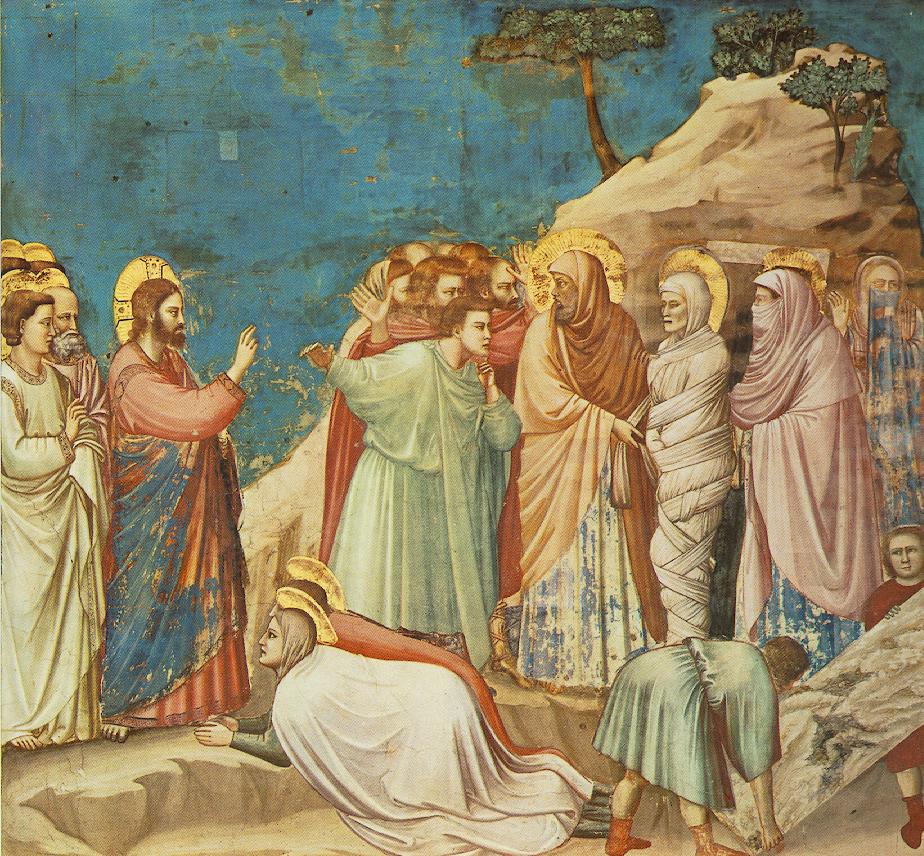
The Raising of Lazarus by “The Resurrection and the Life”
John 11 tells the story of the death of Lazarus. Jesus had heard of Lazarus’ illness, and though he was a close friend of the family’s had decided to take his sweet time in making the relatively short trip to see him. In the meantime, Lazarus had died. When Jesus finally showed up, Mary was too grieved to come and meet him, but Martha put words to the painful thought that was weighing heavily on both of their minds, and also to the hope that Martha scarcely dared acknowledge. Jesus’ response foreshadows both the miracle that was soon to come and his own glorious victory over death:
“Lord,” Martha said to Jesus, “if you had been here, my brother would not have died. But I know that even now God will give you whatever you ask.” Jesus said to her, “Your brother will rise again.” Martha answered, “I know he will rise again in the resurrection at the last day.” Jesus said to her, “I am the resurrection and the life. He who believes in me will live, even though he dies; and whoever lives and believes in me will never die. Do you believe this?”
Do you believe this?
Along with “who do people say I am. . .what do you say?” Jesus’ question here is one of the key questions of the Christian faith. I am the resurrection and the Life, says Jesus. Do you believe this?
Most people do not have trouble believing that Jesus existed, that he was a great teacher, and even that he performed miracles. These are near-universally acknowledged facts of history. But the resurrection is a line in the sand. The whole of the Christian faith stands or falls on this event, a fact that the Bible readily admits. “If Christ has not been raised,” says the Apostle Paul, “our preaching is useless and so is your faith.” Indeed, “if Christ has not been raised, your faith is futile; you are still in your sins.” Morover, “those who have fallen asleep in Christ are lost.” And to top it all off, “if only for this life we have hope in Christ, we are to be pitied more than all men.” (1 Cor 15:12–18).
Elsewhere Paul makes it clear that the resurrection is not just essential to the Christian hope—that we too will one day be raised from the dead—but to the faith itself. In Romans 10:9 we are told that “if you confess with your mouth that Jesus is Lord, and believe in your heart that God raised him from the dead, you will be saved.” In other words, belief in the resurrection is essential to salvation. It is not sufficient to believe that Jesus existed. In order to call yourself a Christian, you must actually believe in the Resurrection. But, to return to Paul’s thought in 1 Cor 15, if you don’t believe in the Resurrection—both His, and ours—why would you bother being a Christian at all?
Jesus is Life itself
But Jesus did not only ask Martha to believe in the Resurrection. The latter half of his claim is just as important; I am the Life. And this claim was not only a comforting reassurance for Martha—“Yes, I could raise him then, but I’m going to do it now”—but also a powerful promise for us, “I am Life Itself.” In order to fully appreciate the significance of this promise we must realise that humanity without Christ is spiritually dead. And by ‘spiritually’ I don’t mean figuratively, but actually; in truth, dead. Those that are alive apart from Christ are so only apparently, not truly. To be without Christ is to be separated from God and to be separated from God is death. Or, to state it in the positive, “to live is Christ. . .” (Php 1:21).
Jesus said, “I have come that they might have life, and have it more abundantly.” Again, there are two parts to this text, both of them powerful truths. We often focus on the second part—Jesus is the abundant life that the Father sent him to give us—but miss the first part: Jesus came to give us life. Before him, I was dead. We cannot, and do not truly live apart from him. Perhaps this is why Paul said, when facing the imminent possibility of his own (physical) death, “To live is Christ, and to die is gain.”
And so the promise of coming alive; of truly and abundantly living in Him comes to those who are spiritually dead because of sin (Eph 2:1). God promises that “if the Spirit of Him who raised Jesus from the dead dwells in you, He who raised Christ from the dead will also give life to your mortal bodies through His Spirit who dwells in you” (Rom 8:11). We who are in Christ, have been resurrected from spiritual death, and the power and life of Christ’s own resurrection courses through our veins. It is His Spirit, the very same Spirit that raised Christ from the dead, who has raised us with him to live a new life in him.


 In
In  Theology Matters